
Watching mortgage rates can feel like staring at a stock ticker — they move, the headlines shout, and it’s hard to know what any of it means for your actual payment. Here’s the reassuring part: the number that matters most isn’t the one on the news, it’s the one built around your specific situation.
I’m Adam Zeman, a licensed loan officer with 15+ years in Wisconsin mortgages. Let me explain what really drives Wisconsin mortgage rates, why your quote differs from the ads, and the concrete things that earn you a lower rate — without any hype about where rates are headed.
What determines your Wisconsin mortgage rate?
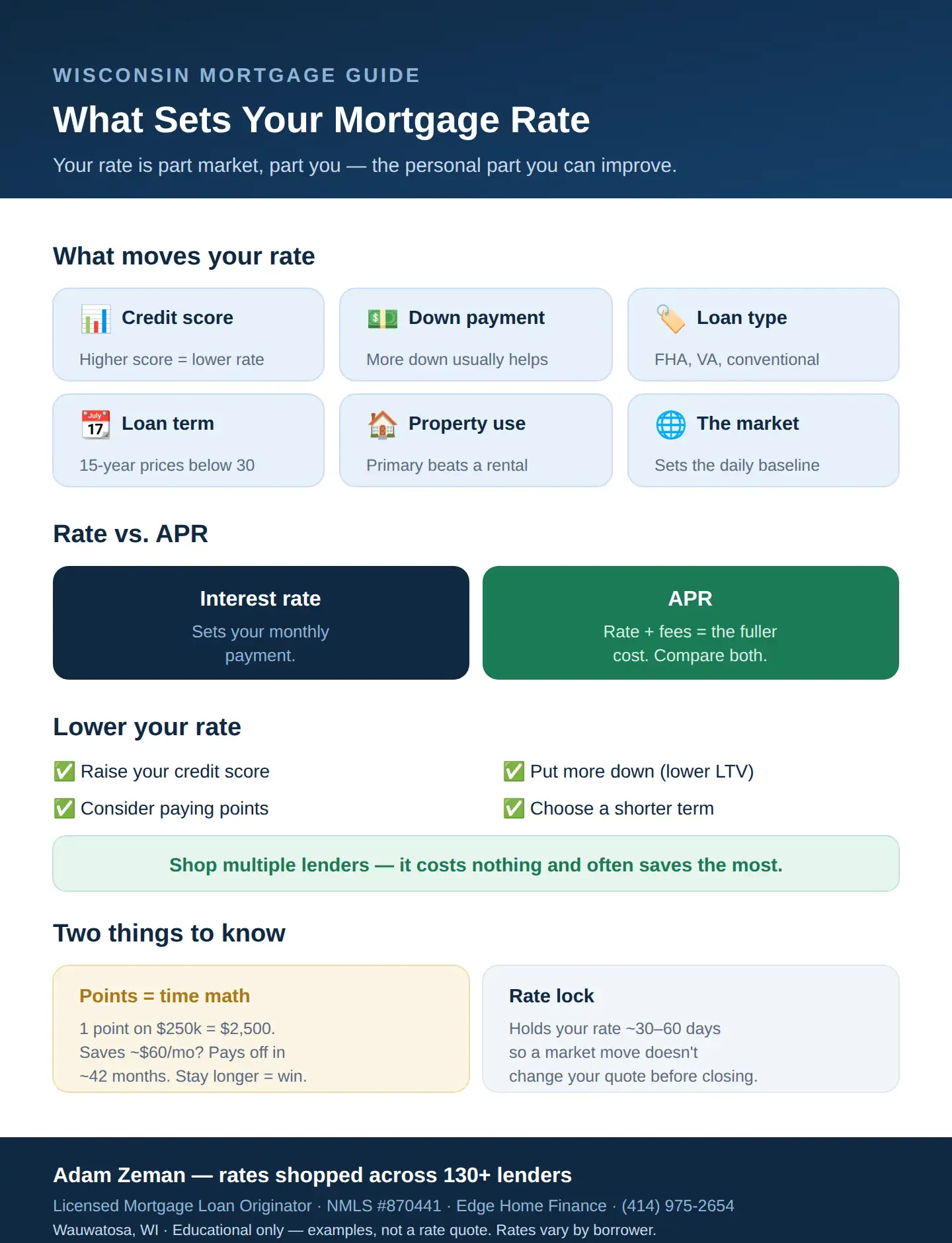
In short, your rate is part market and part you. The market sets the baseline each day, and then the lender adjusts up or down based on how much risk your file carries. Because those adjustments are personal, the same market can produce very different quotes.
| Factor | How it moves your rate |
|---|---|
| Credit score | Higher score, lower rate — one of the biggest levers |
| Down payment | More down usually means a better rate |
| Loan type | Conventional, FHA, VA, and jumbo price differently |
| Loan term | A 15-year usually carries a lower rate than a 30-year |
| Property & use | A primary home prices better than a rental |
So when you see a single advertised rate, remember it assumes a perfect borrower. Your real number depends on the mix above.
Why is my rate different from the advertised rate?
Advertised rates are the best-case scenario — top credit, a healthy down payment, a specific loan type, and often paying points to buy the rate down. Most real borrowers don’t match every one of those assumptions, so the everyday quote lands somewhere different.
That’s not a bait-and-switch; it’s just how pricing works. For example, if the ad assumes a 780 credit score and 25% down and you’re at 700 with 5% down, your rate will reflect that. The honest move is to get a quote built on your real numbers, which is exactly what I do.
How can you get lower Wisconsin mortgage rates?
You have more control over Wisconsin mortgage rates than most people realize. While you can’t move the market, you can improve the parts of the file the lender prices. Here are the levers that actually work.
| Lever | Why it helps |
|---|---|
| Raise your credit score | Even a small bump can move you into a better price tier |
| Put more down | Lower loan-to-value (LTV) often earns a better rate |
| Consider points | Paying points upfront buys a lower rate — worth it if you stay long enough |
| Shorten the term | A 15-year rate is usually lower than a 30-year |
| Shop multiple lenders | Pricing varies, so comparing is the simplest win |
Notice that the last one costs you nothing. Because lender pricing genuinely differs, simply comparing offers is often the easiest way to save.
What’s the difference between the rate and the APR?
These two numbers confuse almost everyone when they compare Wisconsin mortgage rates, so here’s the plain version. The interest rate is what your monthly payment is based on. The annual percentage rate (APR) folds in the rate plus certain fees, so it reflects the fuller cost of the loan over its life.
That’s why a loan with a slightly lower rate can actually have a higher APR — it may carry more fees. So when you compare offers, look at both: the rate for the payment, and the APR for the overall cost. I’ll walk you through both on any quote so nothing hides in the fine print.
Should you pay points to lower your rate?
Points are one more piece of Wisconsin mortgage rates: optional upfront money you pay to buy your rate down, and whether they’re worth it comes down to time. One point costs 1% of the loan and lowers the rate a set amount.
Let’s put it in dollars. On a $250,000 loan, one point is $2,500. If that point saves you $60 a month, it pays for itself in about 42 months — so it’s a win if you’ll keep the loan past then, and a loss if you’ll sell or refinance sooner. I run this break-even for you so points are a decision, not a guess.
How does a rate lock work?
Once you’re happy with one of the Wisconsin mortgage rates you’ve been quoted, a rate lock holds it in place for a set window — commonly 30 to 60 days — so a market move doesn’t change your quote before closing. It protects you if rates rise while your loan moves through processing.
The trade-off is that if rates fall after you lock, you’re generally held to your locked rate, though some lenders offer a one-time float-down. Timing the lock is part of the strategy, and it’s something I help you decide rather than leaving it to chance.
Are Wisconsin mortgage rates different from other states?
People often assume Wisconsin mortgage rates run on their own schedule, but the underlying market rate is national, so Wisconsin isn’t separate. That said, a few local factors touch your overall cost: Wisconsin’s higher property taxes affect your total payment, and state-specific closing costs and available loan programs can shift the full picture. The rate itself is mostly about you and the market — not your zip code.
How do you find the best Wisconsin mortgage rates?
The most reliable way to compare Wisconsin mortgage rates is to let one file be shopped across many lenders at once. Because each lender prices risk a little differently, the same borrower can get meaningfully different quotes — and you only benefit if someone actually compares them. That’s what I do: I take your real numbers and shop them across 130+ lenders to find the best genuine rate for your situation. If you’re weighing a purchase, my guide on buying your first home in Wisconsin pairs well with this.
Frequently asked questions
What credit score do I need for the best mortgage rate?
Generally the higher the better: the strongest Wisconsin mortgage rates often open up in the mid-700s and above. Even a modest score increase can move you to a better tier.
Do mortgage rates change daily?
Yes. Wisconsin mortgage rates move day to day and sometimes within a day, which is why a quote is a snapshot until you lock it.
Is the lowest rate always the best deal?
Not always. A rock-bottom rate can come with higher fees, so compare the APR and the closing costs, not just the headline rate.
Does shopping lenders hurt my credit?
Barely. Lenders typically treat multiple mortgage inquiries within a short window as one, so comparing offers won’t meaningfully dent your score.
Should I lock my rate now or wait?
It depends on your timeline and comfort with risk. Locking protects you from increases; waiting is a gamble on the market. I’ll help you weigh it for your closing date.
What is a mortgage point?
It’s upfront money — one point equals 1% of the loan — that you pay to lower your rate. It’s worth it only if you keep the loan past the break-even.
Can I refinance later if rates drop?
Often, yes. If rates fall enough to beat your closing costs within the time you’ll stay, refinancing can capture the savings.
Why did I get a higher rate on an investment property?
Rentals carry more risk, so Wisconsin mortgage rates run higher on them than on a primary home. A larger down payment can help offset it.
Key takeaways
- Your Wisconsin mortgage rate is part market and part you — credit, down payment, loan type, and property all shape it.
- Advertised rates assume a best-case borrower, so your real quote will usually differ.
- Compare the rate and the APR — the lowest rate isn’t always the cheapest loan.
- Also weigh points against how long you’ll keep the loan before they pay off.
- Because lender pricing varies, shopping multiple lenders is the simplest way to a better rate.
Want a real rate built on your numbers?
Send me your basics and I’ll shop your file across 130+ lenders and show you an honest quote — the rate, the APR, and the costs, with nothing buried. Grab a 15-minute call on my calendar, or call or text me at (414) 975-2654.
Adam Zeman — Licensed Mortgage Loan Originator, NMLS #870441 — Edge Home Finance, LLC, Company NMLS #891464 — 11220 W Burleigh St, Suite 174, Wauwatosa, WI 53222 — (414) 975-2654 — Book: calendly.com/adam-zeman/30min. Educational information only, not a rate quote or commitment to lend. Mortgage rates are examples for illustration and vary by borrower, credit, loan type, and market conditions. All loans subject to credit approval and underwriting. Equal Housing Opportunity.