
If you’ve been putting off buying because you’re not sure your credit is “good enough,” take a breath — the bar is often lower than people think. The credit score to buy a house isn’t one magic number, and plenty of Wisconsin buyers get in with credit they assumed would hold them back.
I’m Adam Zeman, a licensed loan officer with 15+ years in Wisconsin mortgages. Let me walk you through the real minimums by loan type, how your score shapes your cost, and the fastest ways to nudge it up — in plain English, with real dollars.
What credit score do you need to buy a house?
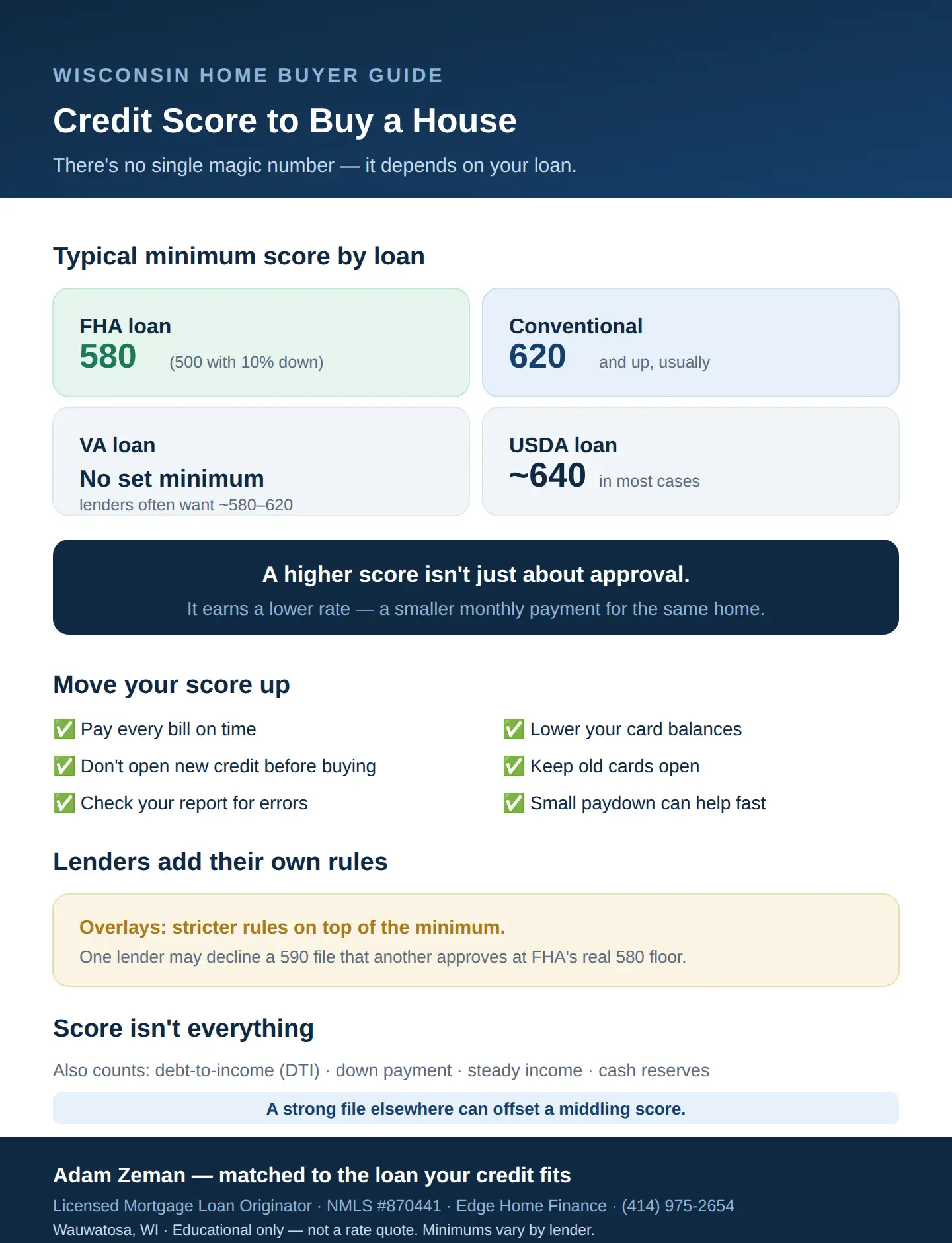
In short, there’s no single number, because each loan type sets its own floor. The credit score to buy a house ranges from around 500 on the low end to 620 and up, depending on which loan you use and how much you put down. Here’s the quick breakdown.
| Loan type | Typical minimum score |
|---|---|
| FHA loan | 580 with 3.5% down (500–579 with 10% down) |
| Conventional loan | Usually 620 |
| VA loan | No set government minimum; many lenders want ~580–620 |
| USDA loan | Often around 640 |
So if your score is in the high 500s, an FHA loan may already be within reach. Because these are just the starting floors, the loan that fits you depends on your full picture, not the score alone.
What credit score is needed for each loan type?
Let’s go a little deeper, because the differences matter. Each program was built for a different kind of buyer, and your score often points you toward the right one.
An FHA loan is the most forgiving on credit — it’s designed to open the door for first-time and rebuilding buyers, which is why the credit score to buy a house with FHA can dip to 580 or even 500. A conventional loan generally wants 620 or higher, but it can cost less over time because its mortgage insurance falls off once you reach 20% equity. A VA loan, for eligible veterans and service members, has no government-set score minimum at all, though individual lenders add their own.
How does your credit score affect buying a house?
Your score does two jobs: it decides whether you qualify, and it sets the rate you’re offered. That second part is where real money lives, because a higher score moves you into a better pricing tier.
For example, on a $250,000 loan, the difference between a fair score and a strong one can easily be a noticeable gap in your rate — and even a small rate difference adds up to thousands of dollars over the years and a higher or lower monthly payment. So improving your score before you buy isn’t just about approval; it’s about paying less for the same house.
Do lenders add their own credit rules?
Yes, and this is the part that surprises people most. On top of each loan’s official minimum, individual lenders layer their own stricter requirements, called overlays. So one lender might decline a 590 FHA file while another approves it at the program’s real 580 floor.
That gap is exactly why the lender you choose matters as much as your score. Because I shop your file across 130+ lenders, I can find the one whose credit rules actually fit your number — instead of you taking one bank’s “no” as the final word.
How can you improve your credit score to buy a house?
The good news is that scores move faster than most people expect, and a few focused steps go a long way. You don’t need perfect credit — you just need to clear your loan’s bar and reach a better rate tier.
| Step | Why it helps |
|---|---|
| Pay every bill on time | Payment history is the biggest piece of your score |
| Lower your card balances | Using less of your limit lifts your score quickly |
| Don’t open new credit before buying | New accounts and hard pulls can ding your score |
| Keep old cards open | Longer credit history helps |
| Check your report for errors | Fixing a mistake can raise your score fast |
Also worth knowing: paying down a credit card can lift your score within a cycle or two, so sometimes a small move right before applying makes a real difference.
What else matters besides your credit score?
Your score is a big piece, but it’s not the whole file. Lenders look at the full picture, so a strong showing elsewhere can offset a middling score.
- Your debt-to-income ratio (DTI) — how much of your income already goes to debt.
- Your down payment — more down can offset a lower score.
- Steady income and employment history.
- Cash reserves left over after closing.
What credit score do you need to buy a house in Wisconsin?
The honest answer is that it depends on your loan type and your full financial picture — and that’s a good thing, because it means a middling score rarely rules you out by itself. That’s the part I handle: I look at your real numbers, match you to the loan your credit fits, and shop it across 130+ lenders. If you’re early in the process, my guide for first-time home buyers in Wisconsin and my overview of FHA loans are great next reads.
Frequently asked questions
What is the lowest credit score to buy a house?
Around 500, using an FHA loan with 10% down. With 3.5% down, the FHA floor is 580. Other loan types generally start higher.
Can I buy a house with a 600 credit score?
Often yes. A 600 score clears the FHA minimum, and some lenders will work with it on other programs, though your rate will reflect it.
What credit score do I need for a conventional loan?
Usually 620 or higher. A stronger score earns a better rate and can lower your mortgage insurance cost.
Does checking my own credit hurt my score?
No. Checking your own credit is a soft inquiry and doesn’t affect your score, so review it freely before you apply.
How long does it take to raise my credit score?
Sometimes just a cycle or two. Paying down balances and fixing report errors can show up quickly, while bigger repairs take longer.
Do I need a perfect score to get a good rate?
No. Rates improve in tiers, so you don’t need an 800 — reaching the next tier up is often enough to save real money.
Will a lower score stop me from buying?
Usually not by itself. A lower score often means a bigger down payment or a higher rate rather than a flat no, especially with FHA.
Should I pay off all my debt before buying?
Not necessarily. Lowering card balances helps, but keeping some cash for your down payment and reserves usually matters more.
Key takeaways
- The credit score to buy a house depends on the loan: ~580 FHA, ~620 conventional, flexible on VA.
- A higher score doesn’t just get you approved — it earns a lower rate and a smaller payment.
- Lenders add their own overlays, so the same score can get different answers — shopping matters.
- Also remember your DTI, down payment, and income shape approval alongside your score.
- Scores can move quickly, so a small step before applying can put you in a better tier.
Not sure if your credit is ready?
Tell me where your credit stands and I’ll show you which loan fits and what you’d qualify for across 130+ lenders — no guessing. Grab a 15-minute call on my calendar, or call or text me at (414) 975-2654.
Adam Zeman — Licensed Mortgage Loan Originator, NMLS #870441 — Edge Home Finance, LLC, Company NMLS #891464 — 11220 W Burleigh St, Suite 174, Wauwatosa, WI 53222 — (414) 975-2654 — Book: calendly.com/adam-zeman/30min. Edge Home Finance, LLC is a private mortgage brokerage and is not affiliated with HUD, the FHA, the VA, the USDA, or any government agency. Educational information only, not a rate quote or commitment to lend. Credit requirements, rates, and loan guidelines vary by lender and by borrower. All loans subject to credit approval and underwriting. Equal Housing Opportunity.