
Figuring out how much house you can afford is the first real question, and it’s the one that keeps people up at night: you don’t want to fall for a home you can’t comfortably carry, but you also don’t want to lowball yourself out of a place you could actually swing. Let’s take the guesswork out of it.
I’m Adam Zeman, a licensed loan officer with 15+ years in Wisconsin mortgages. Below is how lenders actually decide what you qualify for, translated into real dollars — so you walk into your search knowing your number.
How much house can I afford on my income?
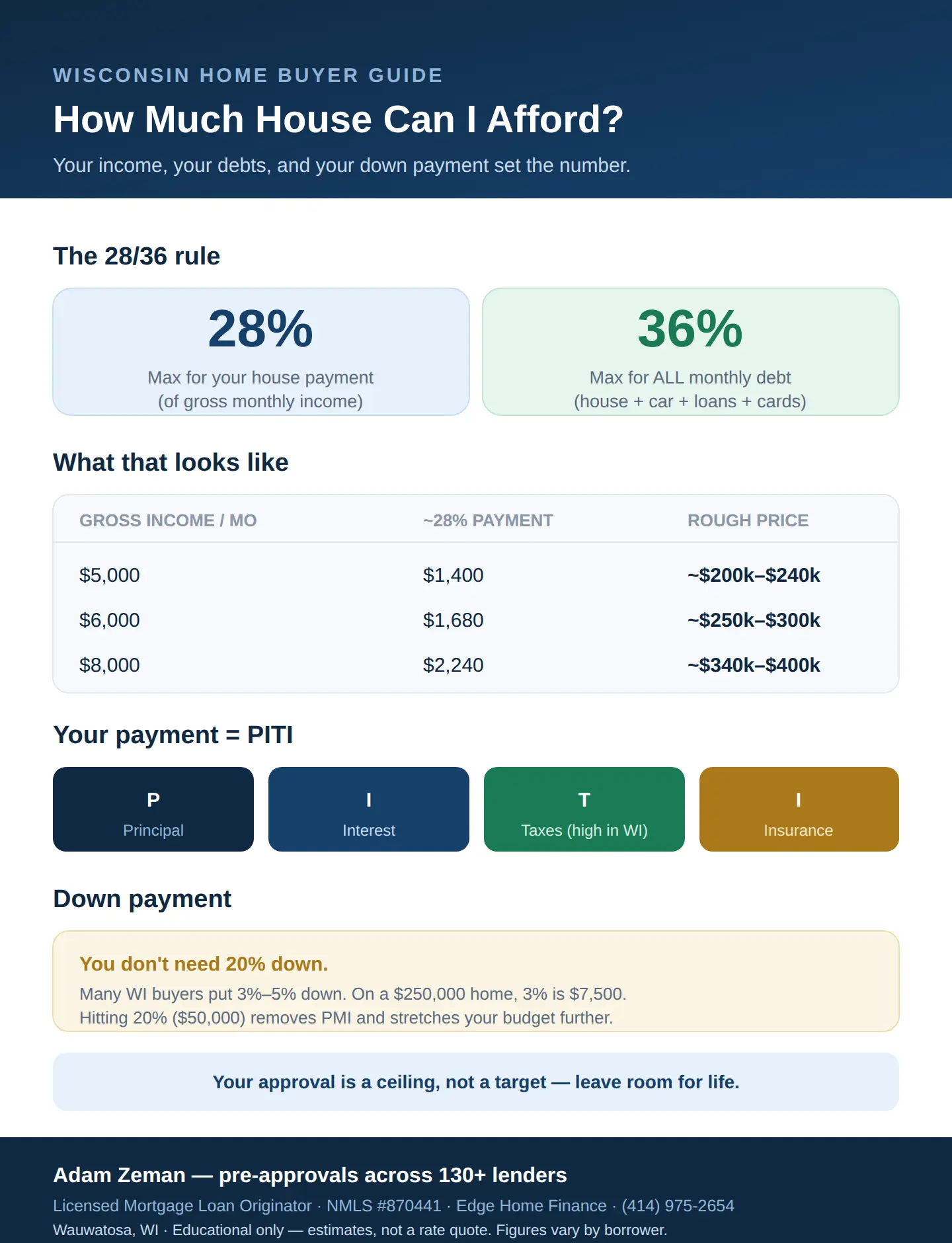
In short, your income sets the ceiling, and your debts and down payment shape what fits under it. So lenders start with your gross monthly income — what you earn before taxes — and apply a couple of percentages to find a payment you can carry. Here’s the quick version, then the details.
| Gross monthly income | ~28% house payment | Rough price range* |
|---|---|---|
| $5,000 | $1,400 | ~$200,000–$240,000 |
| $6,000 | $1,680 | ~$250,000–$300,000 |
| $8,000 | $2,240 | ~$340,000–$400,000 |
*Rough ranges that shift with rates, taxes, insurance, and your down payment. Think of them as a starting point, not a promise.
What is the 28/36 rule?
The 28/36 rule is the shorthand lenders lean on. It says your house payment should stay under 28% of your gross monthly income, and all your monthly debt combined — house, car, student loans, credit cards — should stay under 36%. Notably, that second number is your debt-to-income ratio (DTI), and it matters just as much as the first.
For example, on $6,000 a month, 28% is $1,680 for the house and 36% is $2,160 for everything. So if you already pay $500 toward a car and student loans, that leaves about $1,660 for the house — the debts quietly pulled your number down. This is exactly why two people with the same income can afford very different homes.
What’s included in the monthly payment?
Your payment is the core of how much house you can afford, and when lenders talk about it, they don’t just mean principal and interest. They mean PITI — principal, interest, taxes, and insurance — and Wisconsin property taxes are a real factor here.
| Part of the payment | What it is |
|---|---|
| Principal | The loan balance you’re paying down |
| Interest | The cost of borrowing |
| Taxes | Property taxes, which run higher in much of Wisconsin |
| Insurance | Homeowner’s insurance, plus PMI if you put under 20% down |
So taxes are a real part of how much house you can afford: because Wisconsin property taxes are on the higher side, they can add a few hundred dollars a month and pull your affordable price down compared to a lower-tax state. I always run your specific county’s numbers so the payment you see is the real one.
How does my down payment change what I can afford?
Your down payment also shapes how much house you can afford, and it does two things at once: it lowers the loan you need, and once you cross 20% down, it removes private mortgage insurance (PMI) — the extra monthly cost lenders charge when you put less down.
So let’s put it in dollars. On a $250,000 home, 3% down is $7,500 and 20% is $50,000. You don’t need 20% to buy — plenty of Wisconsin buyers put down 3% to 5% — but a bigger down payment shrinks both the loan and the insurance, which stretches how much home your payment covers.
What else affects how much house I can afford?
When it comes to how much house you can afford, income and debts are of course the big levers, but a few other things move how much house you can afford more than people expect. Being aware of them early keeps surprises out of your pre-approval.
- Your credit score — a higher score earns a lower rate, which lowers the payment.
- Your loan type — FHA, conventional, and VA each qualify you a little differently.
- Property taxes — they vary a lot by Wisconsin county and town.
- Your comfort level — what a lender approves and what you want to spend aren’t always the same number.
How much house can I afford in Wisconsin specifically?
The honest answer is that it depends on your full picture, and that’s where a real conversation beats any calculator. Because your rate, taxes, debts, and loan type all pull on the number, the same income can land differently from one buyer to the next. That’s the part I handle — I look at your actual situation and shop it across 130+ lenders so your pre-approval reflects the best real terms, not a generic estimate. If you’re just getting started, my guide for first-time home buyers in Wisconsin is a good next step.
Frequently asked questions
How much income do I need to buy a $300,000 house?
Often somewhere around $6,000–$7,000 a month in gross income, depending on your debts, down payment, rate, and property taxes. Less debt lets you do it on less income.
What is a good debt-to-income ratio?
As a rule, lenders like total debt under 36% of gross income, though many loans allow more with strong credit or a larger down payment.
Do I really need 20% down?
No. In fact, many Wisconsin buyers put down 3% to 5%. Putting 20% down removes PMI, but it’s not required to buy.
Does my credit score change how much I can afford?
Yes. In fact, a higher score usually means a lower rate, and a lower rate means a lower payment — which raises the price you can carry.
Are Wisconsin property taxes really that high?
Yes, and because they’re part of your payment, they matter: property taxes are on the higher side nationally and vary by county. Because taxes are part of your payment, they can meaningfully lower your affordable price.
Should I borrow the maximum I’m approved for?
Not necessarily. After all, your approval is a ceiling, not a target — it’s smart to pick a payment that leaves room for life.
How do I find my real number fast?
Honestly, a pre-approval does it. It checks your income, debts, and credit and gives you an actual price range to shop with confidence.
Does a car loan lower how much house I can afford?
Yes. As a result, every monthly debt counts against your 36%, so a car payment or student loan directly trims your house budget.
Key takeaways
- How much house you can afford is driven by income, monthly debts, and your down payment.
- The 28/36 rule: keep the house payment under 28% of gross income and total debt under 36%.
- Your payment is PITI — and higher Wisconsin property taxes pull the affordable price down.
- Also remember 20% down isn’t required, but it removes PMI and stretches your budget.
- Finally, your approval is a ceiling, not a target — pick a payment that still leaves room for life.
Want your real number?
Tell me your income, your monthly debts, and how much you’ve saved, and I’ll show you the actual price range you can afford across 130+ lenders. Grab a 15-minute call on my calendar, or call or text me at (414) 975-2654.
Adam Zeman — Licensed Mortgage Loan Originator, NMLS #870441 — Edge Home Finance, LLC, Company NMLS #891464 — 11220 W Burleigh St, Suite 174, Wauwatosa, WI 53222 — (414) 975-2654 — Book: calendly.com/adam-zeman/30min. Educational information only, not a rate quote or commitment to lend. Payment examples are estimates; actual figures vary by rate, taxes, insurance, credit, and lender. All loans subject to credit approval and underwriting. Equal Housing Opportunity.