So rates moved, a mailer showed up, and now you’re asking yourself the same thing half of Wisconsin is asking: should I refinance my mortgage, or leave it alone? It’s a fair question, and the honest answer is that it depends on your numbers — not on whatever a rate ad is shouting this week.
I’m Adam Zeman, a licensed loan officer with 15+ years in Wisconsin mortgages. Let me walk you through how to decide, in plain English and real dollars, so you can tell whether a refinance actually puts money back in your pocket or just moves it around.
Should I refinance my mortgage right now?
In short, a refinance makes sense when it either lowers your total cost or solves a specific problem — and you stay in the home long enough to come out ahead. Because every refinance has closing costs, the math has to clear that hurdle first. Here’s the quick way to sanity-check it before we dig into the details.
| Refinance likely helps if… | Probably hold off if… |
|---|---|
| You can meaningfully lower your rate | You’ll move or sell within a year or two |
| You want to drop mortgage insurance (PMI) | The savings don’t beat the closing costs |
| You want a shorter term to pay off faster | You’d stretch the loan back out and pay more long-term |
| You need cash from equity for a real purpose | You’re only chasing a tiny rate change |
How does the break-even point work?
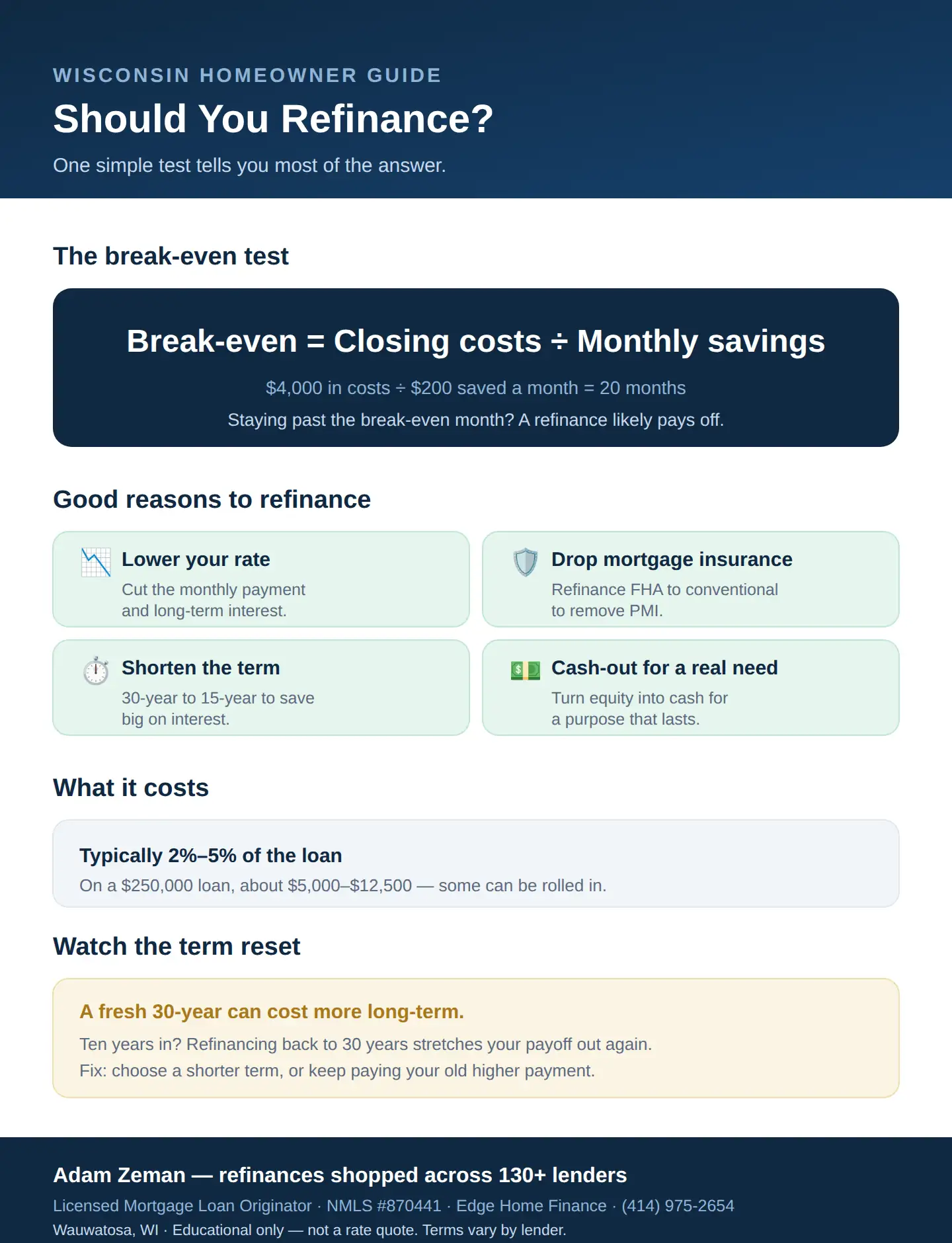
The break-even point is the clearest test there is, and it’s simple math. You take your total closing costs and divide by how much you’ll save each month. The result is the number of months it takes for the refinance to pay for itself.
Break-even (months) = closing costs ÷ monthly savings
For example, say your refinance costs $4,000 and it drops your payment by $200 a month. That’s a 20-month break-even. So if you’ll be in the home longer than 20 months, you come out ahead; if you’re planning to sell next year, you’d lose money on the deal. This one calculation answers most of the “should I refinance my mortgage” question by itself.
What are good reasons to refinance your mortgage?
There’s more than one reason to refinance, and they’re not all about the rate. Here are the ones that tend to actually pay off.
| Type of refinance | What it does |
|---|---|
| Rate-and-term | Lowers your rate or changes your loan length |
| Cash-out | Turns equity into cash for a set purpose |
| Remove mortgage insurance | Refinances an FHA loan into conventional to drop the premium |
| Shorten the term | Moves you from a 30-year to a 15-year to save on interest |
Notice that lowering the rate is only one of four. Dropping mortgage insurance or shortening the term can save you real money even when rates haven’t moved much at all.
How much does it cost to refinance in Wisconsin?
A refinance has closing costs, just like your original mortgage did. In Wisconsin, they typically run somewhere around 2% to 5% of the loan amount, covering the appraisal, title work, lender fees, and recording. On a $250,000 loan, that’s roughly $5,000 to $12,500.
Here’s the part worth knowing: some of that can often be rolled into the loan or offset with a lender credit, so you’re not always writing a big check at closing. I’ll show you both versions — paying costs upfront versus rolling them in — so you can see which one actually saves you more over the time you’ll keep the loan.
Does refinancing reset your loan term?
Yes, and this is the trap people fall into. If you’re ten years into a 30-year loan and you refinance into a brand-new 30-year, you’ve just stretched your payoff back out to 30 years. Your monthly payment might drop, but you could pay more interest over the full life of the loan.
There’s an easy fix, though. You can refinance into a shorter term — say a 20- or 15-year — or simply keep making your old higher payment on the new lower-rate loan. Either way, you capture the savings without resetting the clock. I always run this comparison so the lower payment isn’t quietly costing you more down the road.
Should you do a cash-out refinance?
A cash-out refinance replaces your mortgage with a larger one and hands you the difference in cash, based on your home’s equity and its loan-to-value ratio (LTV) — how much you owe compared to what the home is worth. It can be a smart, lower-rate way to fund a genuine need, like consolidating higher-interest debt or a real home project.
That said, it’s borrowing against your home, so the reason matters. Using it to wipe out 22% credit-card debt can be a clear win; using it to fund something that won’t last is where people get into trouble. I’ll help you weigh whether the trade-off actually works in your favor.
Should I refinance my mortgage? Deciding in Wisconsin
The decision comes down to your rate, your costs, and how long you’ll stay — and those are different for every borrower. Because lender pricing varies, the same refinance can be worth it at one lender and a wash at another. That’s the part I handle: I shop it across 130+ lenders and show you the real break-even so you’re deciding on facts, not a mailer. If you want the full overview first, see my guide to refinancing in Wisconsin.
Frequently asked questions
How much lower does my rate need to be to refinance?
There’s no magic number. What matters is whether the monthly savings beat the closing costs within the time you’ll keep the home — that’s the break-even test.
Should I refinance my mortgage to remove PMI?
Often yes, if you have an FHA loan and enough equity. Refinancing into a conventional loan can drop the mortgage insurance premium entirely.
Does refinancing hurt my credit?
Only slightly and briefly. The lender pulls your credit, which can dip your score a few points, but that usually recovers quickly.
How long does a refinance take?
Commonly around 30 to 45 days, though a well-prepared file can move faster. Getting your documents in early keeps it on track.
Can I refinance if my home value dropped?
Sometimes. It depends on your loan-to-value ratio (LTV) and loan type; certain programs allow higher LTVs, so it’s worth checking rather than assuming.
Is a no-closing-cost refinance real?
Yes, but the costs don’t vanish — they’re covered by a slightly higher rate or rolled into the balance. It can still be the right move; you just want to see the math.
Should I refinance from a 30-year to a 15-year?
If you can handle the higher payment, it can save a large amount of interest. I’ll show you the monthly difference so you can decide if it fits your budget.
How often can I refinance?
There’s no hard limit, but each refinance has costs, so it only makes sense when the numbers clear the break-even each time.
Key takeaways
- The core test for whether you should refinance your mortgage is the break-even: closing costs ÷ monthly savings.
- Good reasons include a lower rate, dropping mortgage insurance (PMI), shortening the term, or a purposeful cash-out.
- Closing costs typically run about 2%–5% of the loan, and some can be rolled in.
- Also watch the term reset — refinancing into a fresh 30-year can cost more long-term unless you shorten it.
- Because lender pricing varies, shopping the refinance is what turns a maybe into a clear yes or no.
Want to see your real break-even?
Send me your current rate, balance, and how long you plan to stay, and I’ll run the numbers across 130+ lenders and show you exactly where you land. Grab a 15-minute call on my calendar, or call or text me at (414) 975-2654.
Adam Zeman — Licensed Mortgage Loan Originator, NMLS #870441 — Edge Home Finance, LLC, Company NMLS #891464 — 11220 W Burleigh St, Suite 174, Wauwatosa, WI 53222 — (414) 975-2654 — Book: calendly.com/adam-zeman/30min. Educational information only, not a rate quote or commitment to lend. Rates, closing costs, and refinance terms vary by lender and by borrower. All loans subject to credit approval and underwriting. Equal Housing Opportunity.