So you’ve found an investment property that pencils out, and now you’re wondering what it actually takes to get the loan. That’s the right question to ask early, because DSCR loan requirements aren’t the same from one lender to the next — and guessing wrong costs you time and, sometimes, the deal.
I’m Adam Zeman, a licensed loan officer with 15+ years in Wisconsin mortgages, and I set up DSCR loans for investors all the time. Below is a plain-English rundown of what you’ll need to qualify — the ratio, the down payment, the credit, and the pieces people forget until closing.
What are the requirements for a DSCR loan?
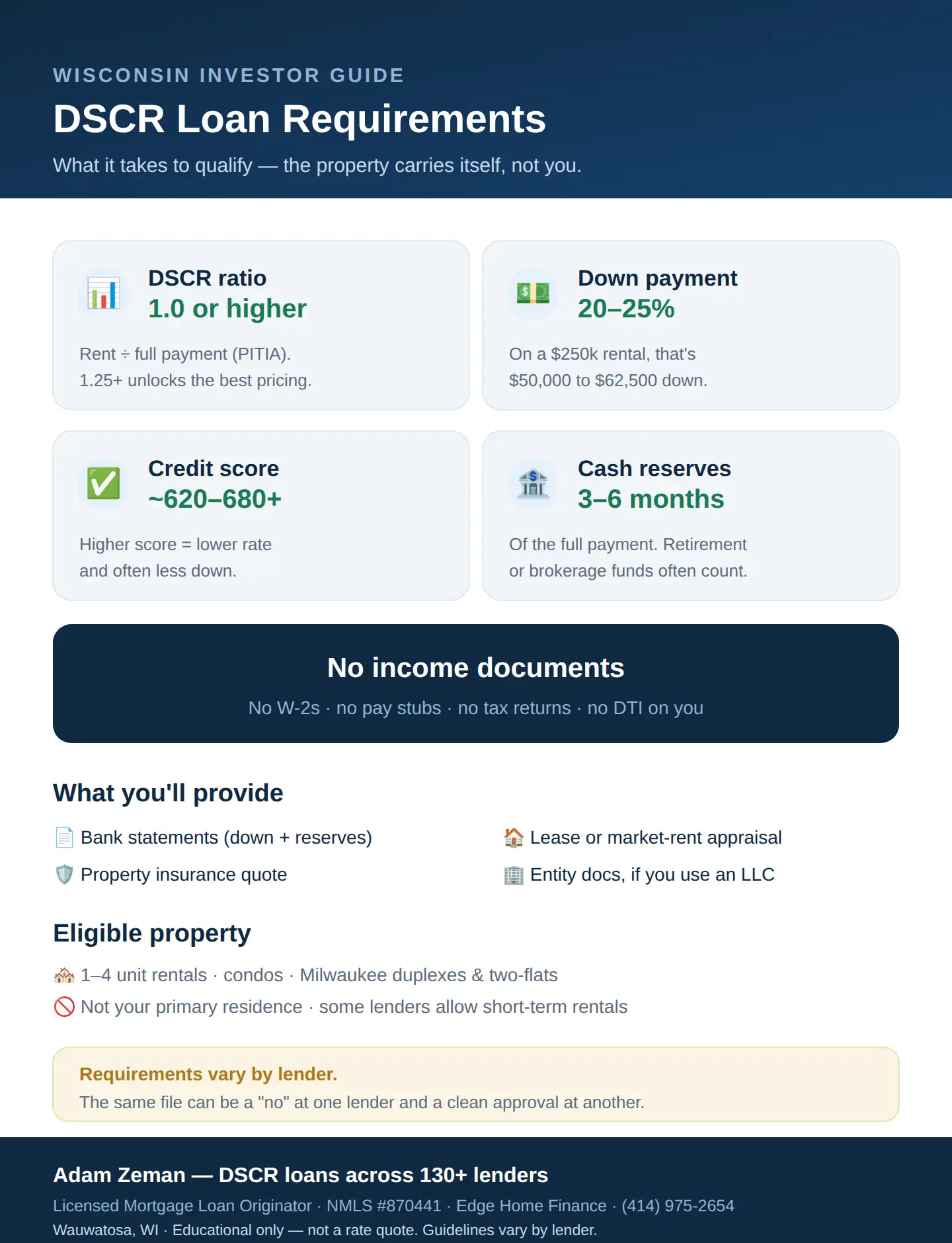
In short, a DSCR loan qualifies the property, not you. That means the requirements center on the property’s numbers and your down payment and credit — not your personal income. Here’s the quick picture, and then we’ll walk through each piece in real dollars.
| Requirement | Typical range |
|---|---|
| DSCR (rent ÷ payment) | 1.0 or higher (some lenders to ~0.75) |
| Down payment | 20–25% of the price |
| Credit score | Around 620–680+ |
| Cash reserves | Usually 3–6 months of payments |
| Property type | 1–4 unit rentals (some allow short-term) |
| Income documents | None — no W-2s, pay stubs, or tax returns |
Keep in mind these are typical ranges. Every lender sets its own overlays, so one may want 25% down where another takes 20% — which is exactly why the lender you choose matters so much.
What DSCR ratio do you need to qualify?
The debt-service coverage ratio (DSCR) is simply the monthly rent divided by the full monthly payment — principal, interest, taxes, insurance, and any HOA dues (PITIA). Most lenders want to see at least 1.0, meaning the rent covers the payment. Land at 1.25 or higher and you’ll unlock the best pricing.
DSCR = monthly rent ÷ monthly payment (PITIA)
For example, say a Milwaukee duplex rents for $2,600 a month and the full payment is $2,300. That’s a DSCR of about 1.13 — the rent covers the payment with a little cushion, and most lenders would work with it. If the rent were only $2,100 against that same payment, you’d be at 0.91, and you’d either need more down or a lender that allows sub-1.0 ratios.
How much down payment do you need for a DSCR loan?
Plan on 20–25% down. Because these are investment properties with no personal income backing them, lenders want more of your own money in the deal than they would on a primary home.
So let’s put that in real dollars. On a $250,000 rental, 20% down is $50,000 and 25% is $62,500. A larger down payment does two useful things: it lowers your payment (which raises your DSCR), and it often buys you a better rate. So if a property’s ratio is borderline, putting more down can be what tips it into approval.
What credit score is required for a DSCR loan?
As a rule, credit is one of the DSCR loan requirements people ask about most, and lenders look for a score somewhere around 620 to 680, and a higher score generally means a lower rate and a smaller down payment. Some lenders will go below 620, but you’ll usually pay for it with a bigger down payment or a higher rate.
Here’s the part that trips people up: two lenders looking at the same 660 score can quote you very different terms, because each one prices credit differently on investment loans. That spread is real money over 30 years, so it pays to compare rather than take the first answer.
Do you need cash reserves for a DSCR loan?
Yes — most lenders want to see reserves, meaning several months of the full payment sitting in the bank after you close. Three to six months is common, and it’s there to prove the property can weather a vacancy or a repair.
For example, on that $2,300-a-month duplex, six months of reserves is about $13,800. It doesn’t have to be cash under the mattress, either — funds in a retirement or brokerage account usually count. I’ll tell you upfront exactly what a given lender counts as reserves so there’s no surprise late in the file.
What documents do you actually need?
In practice, this is where a DSCR loan feels different from a normal mortgage. Because you’re not being underwritten on personal income, the paperwork is lighter and centered on the property.
| You’ll usually provide | You won’t need |
|---|---|
| Bank statements (for down payment + reserves) | Tax returns |
| The lease or a market-rent appraisal | W-2s or pay stubs |
| Credit report (pulled by the lender) | Debt-to-income (DTI) calculation on you |
| Property insurance quote | Employment verification |
| Entity docs, if you close in an LLC | Years of personal income history |
As a result, that lighter file is a big reason DSCR loans can close faster than a conventional loan — there’s simply less to verify.
What property types qualify?
By design, Property type is another of the DSCR loan requirements to keep in mind. DSCR loans are built for investment property, so the home can’t be your residence. Still, beyond that they’re flexible: single-family rentals, condos, and 2-to-4-unit buildings all typically qualify, and Milwaukee’s many duplexes and two-flats are a natural fit because the combined rent often makes the ratio stronger. Some lenders also allow short-term rentals, though they’ll usually want a rental history or a projection to support the income.
How do Wisconsin DSCR loan requirements compare to a conventional loan?
So the clearest way to see it is side by side. A conventional investment loan can offer a lower rate, but it underwrites you — your income, your DTI, your tax returns. A DSCR loan trades a slightly higher rate for far less scrutiny of your personal finances.
| DSCR loan | Conventional investment loan | |
|---|---|---|
| Qualifies on | The property’s rent | Your personal income |
| Income docs | None | Tax returns, W-2s, pay stubs |
| Number of properties | Often unlimited | Usually capped around 10 |
| Typical rate | A bit higher | A bit lower |
If you want the full picture of how the loan itself works, see my guide to DSCR loans in Wisconsin, or start with the basics in what a DSCR loan is.
How do you meet DSCR loan requirements in Wisconsin?
Above all, the single biggest lever is the lender. Because every lender sets its own minimums on ratio, credit, down payment, and reserves, the same file can get a “no” at one shop and a clean approval at another. That’s the part I handle — I shop your loan across 130+ lenders and match your property to the one whose DSCR box it actually fits.
Frequently asked questions
What is the minimum DSCR to qualify?
Most lenders start at 1.0, where the rent covers the payment. Some go to about 0.75 with a larger down payment, and 1.25+ opens the best pricing.
What credit score do I need for a DSCR loan?
Generally around 620–680. A higher score usually earns a lower rate and can reduce the down payment required.
How much down payment is required?
Typically 20–25% of the purchase price. On a $250,000 rental, that’s $50,000 to $62,500.
Do DSCR loans check my income?
No. There are no pay stubs, W-2s, or tax returns, and no debt-to-income (DTI) calculation on you.
How much in reserves will I need?
Usually three to six months of the full payment, and retirement or brokerage funds often count.
Can I close a DSCR loan in an LLC?
Yes. You can typically close in your own name or an LLC — just plan to provide the entity documents.
Can I use a DSCR loan for a short-term rental?
Sometimes. Certain lenders allow it but will want a rental history or a supported projection for the income.
Will a lower credit score disqualify me?
Not automatically. A lower score usually means a bigger down payment or a higher rate rather than a flat no — which is why shopping lenders matters.
Key takeaways
- The main DSCR loan requirements are a ratio near 1.0+, 20–25% down, credit around 620–680, and 3–6 months of reserves.
- DSCR = monthly rent ÷ monthly payment (PITIA); a higher ratio means better pricing.
- There are no income documents — no W-2s, pay stubs, tax returns, or DTI on you.
- Also plan for the property to be an investment (1–4 units), not your residence.
- Requirements vary a lot by lender, so who you send the file to decides whether it closes.
Want to know if your property qualifies?
Tell me about the property and I’ll run the numbers across 130+ lenders and show you exactly where it lands. Grab a 15-minute call on my calendar, or call or text me at (414) 975-2654.
Adam Zeman — Licensed Mortgage Loan Originator, NMLS #870441 — Edge Home Finance, LLC, Company NMLS #891464 — 11220 W Burleigh St, Suite 174, Wauwatosa, WI 53222 — (414) 975-2654 — Book: calendly.com/adam-zeman/30min. Educational information only, not a rate quote or commitment to lend. DSCR loan guidelines, ratios, credit, down payment, and reserve requirements vary by lender and by borrower. All loans subject to credit approval and underwriting. Equal Housing Opportunity.