
You’ve saved for a down payment and you’re feeling ready — then someone mentions “cash to close” and the number is bigger than you expected. That surprise is one of the most common stumbles for first-time buyers, and it’s completely avoidable once you know what’s actually in that figure.
I’m Adam Zeman, a licensed loan officer with 15+ years in Wisconsin mortgages. Let me break down exactly what makes up your cash to close, run a real example, and show you the honest ways to bring less to the table.
What is cash to close?
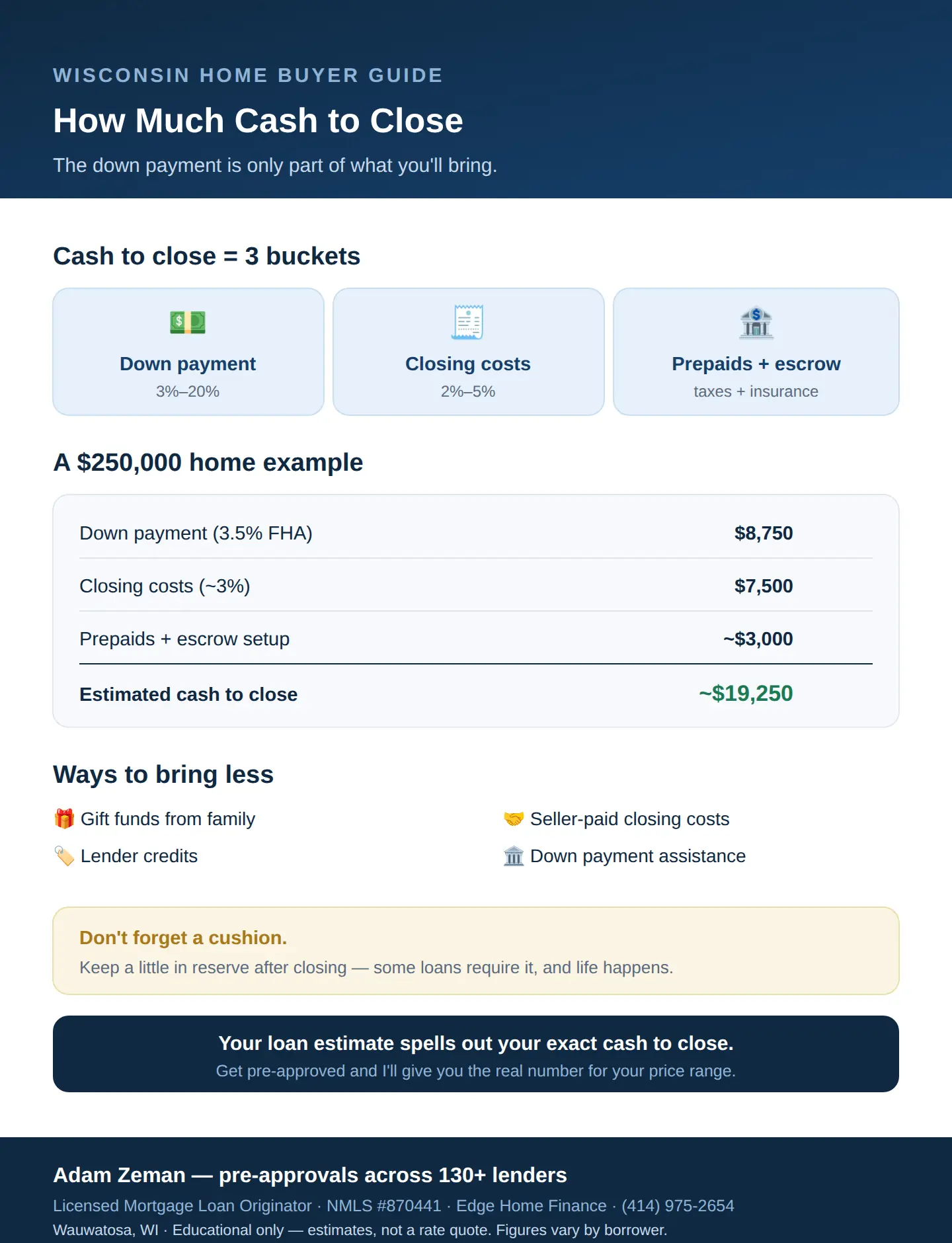
In short, cash to close is the full amount of money you need on closing day. People assume it’s just the down payment, but it’s really three buckets combined: your down payment, your closing costs, and prepaid items the lender collects up front. So the total is always more than the down payment alone.
Because that difference catches so many buyers off guard, knowing the full number early lets you plan with confidence instead of scrambling at the last minute.
What makes up your cash to close?
So let’s open up the three buckets. Each one is straightforward once you see it laid out.
| Bucket | What it covers | Rough size |
|---|---|---|
| Down payment | Your equity in the home | 3%–20% |
| Closing costs | Lender, title, appraisal, recording fees | 2%–5% |
| Prepaids & escrow | Upfront taxes and homeowner’s insurance | Varies |
Notably, those prepaid taxes and insurance are the piece people forget. Because Wisconsin property taxes run higher than average, that bucket can be a few thousand dollars on its own.
How much cash to close do you really need?
So let’s put real numbers on a $250,000 home with 3.5% down. First, the down payment is $8,750, so start there. Then closing costs at roughly 3% add about $7,500. Finally, prepaids and escrow setup add around $3,000.
| Item | Amount |
|---|---|
| Down payment (3.5%) | $8,750 |
| Closing costs (~3%) | $7,500 |
| Prepaids + escrow | ~$3,000 |
| Estimated cash to close | ~$19,250 |
So the real number here is close to $19,000, not the $8,750 many buyers plan for. That’s exactly why seeing the full figure early matters.
How can you lower your cash to close?
Still, the good news is there are several honest ways to bring less. Because these stack, most first-time buyers use more than one.
- Gift funds — a family member can gift part or all of the down payment.
- Seller-paid closing costs — a seller can contribute toward your costs.
- Lender credits — a slightly higher rate can cover some costs.
- Down payment assistance — many Wisconsin buyers qualify for help.
Between these, plenty of buyers get to closing with far less than the sticker number suggests.
Should you spend every dollar on cash to close?
No, and above all this is important. Also, even after covering your cash to close, keep a cushion in the bank. Some loans require a few months of reserves, and beyond that, life happens — a repair, a job gap, a surprise bill. So plan to have a little left over rather than emptying your account at the closing table.
How do I find my exact cash to close in Wisconsin?
The honest answer is that your loan estimate spells it out, down to the dollar, once you’re under contract. Before that, a pre-approval gives you a reliable target for your price range. That’s what I do — I run your real numbers, including Wisconsin’s taxes, and shop your loan across 130+ lenders. If you’re early on, my first-time home buyer guide pairs well with this.
Frequently asked questions
Is cash to close the same as the down payment?
No. In fact, cash to close is the down payment plus closing costs plus prepaid taxes and insurance, so it’s always higher.
How much are closing costs in Wisconsin?
Typically 2%–5% of the price, covering lender, title, appraisal, and recording fees.
Can the seller pay my cash to close?
Yes, a seller can cover part of your closing costs, which lowers your cash to close, though limits apply by loan type.
Can my down payment be a gift?
In most cases, yes. As a rule, gift funds from family are a common, allowed way to reduce what you bring.
Do I get my earnest money back at closing?
Yes, in effect — your earnest money deposit is credited toward your cash to close.
Why are prepaids part of cash to close?
Because the lender collects some property taxes and insurance up front to fund your escrow account.
How early can I know my number?
Generally, a pre-approval gives a solid estimate, and your official loan estimate confirms it once you’re under contract.
Do I need reserves on top of cash to close?
Sometimes. In fact, certain loans want a few months of payments in the bank after closing.
Key takeaways
- Cash to close is the down payment plus closing costs plus prepaid taxes and insurance.
- On a $250,000 home with 3.5% down, plan for roughly $19,000, not just the down payment.
- Wisconsin’s higher property taxes make the prepaid bucket larger than buyers expect.
- Also use gifts, seller credits, lender credits, and assistance to bring less.
- Keep a cushion after closing — don’t spend your last dollar to get the keys.
Want your real number?
Tell me your price range and I’ll show you the full cash to close across 130+ lenders. Grab a 15-minute call on my calendar, or call or text me at (414) 975-2654.
Adam Zeman — Licensed Mortgage Loan Originator, NMLS #870441 — Edge Home Finance, LLC, Company NMLS #891464 — 11220 W Burleigh St, Suite 174, Wauwatosa, WI 53222 — (414) 975-2654 — Book: calendly.com/adam-zeman/30min. Educational information only; figures are estimates, not a rate quote or commitment to lend. Costs vary by lender and by borrower. All loans subject to credit approval and underwriting. Equal Housing Opportunity.