
You love your home, but that dated kitchen or the roof that’s on its last legs keeps nagging at you — and renovation quotes aren’t cheap. If you’ve built up equity, a cash-out refinance can turn that equity into the funds to finally get the work done, often at a far better rate than other financing.
I’m Adam Zeman, a licensed loan officer with 15+ years in Wisconsin mortgages. Let me walk you through how a cash-out refinance for home improvements works, when it’s the smart tool, and how it stacks up against the alternatives — in plain dollars.
How does a cash-out refinance for home improvements work?
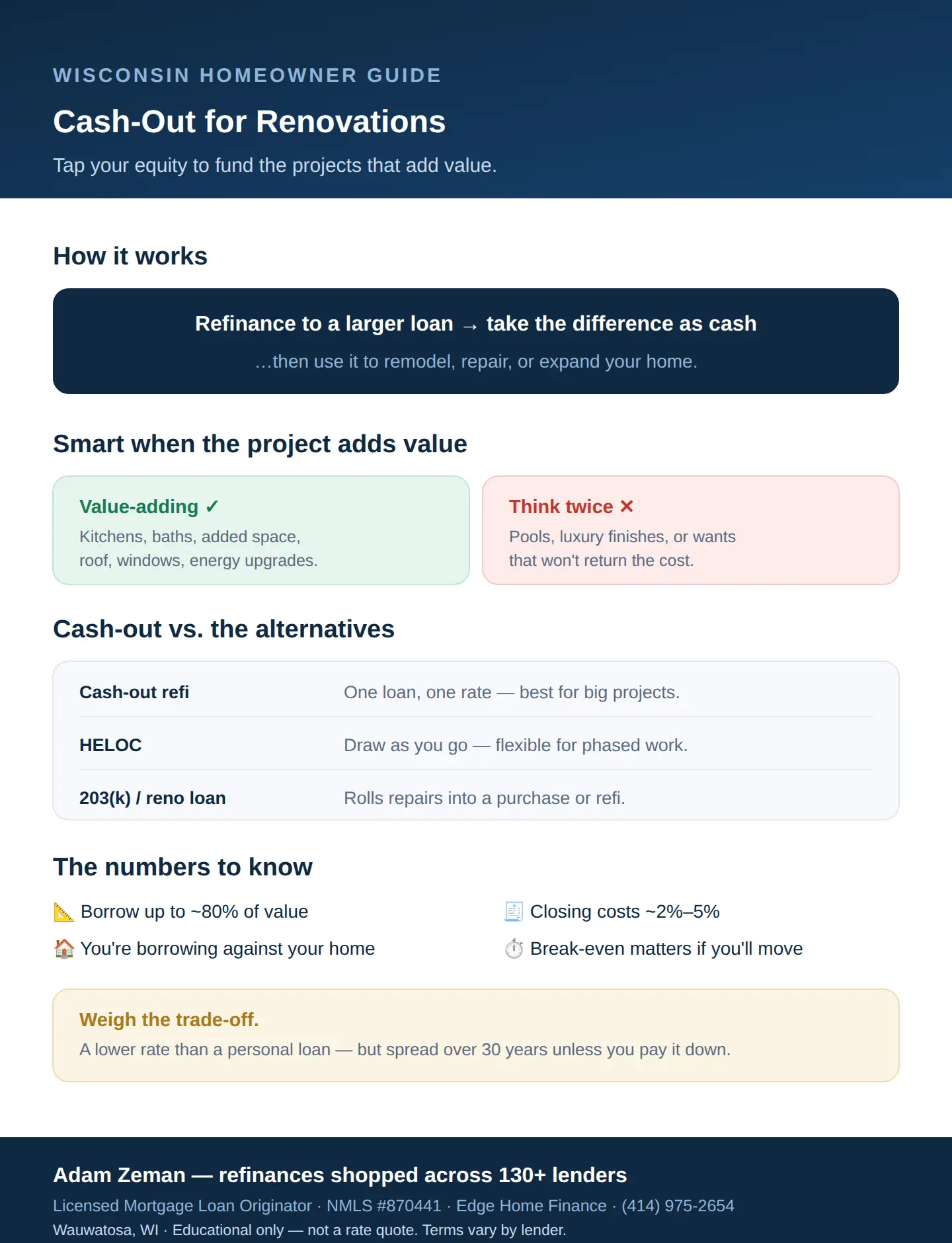
In short, you refinance into a new, larger mortgage and take the extra amount as cash. Then you use that cash to pay for your renovations. Because the whole project is folded into your mortgage, you’re financing it at your mortgage rate rather than a pricier credit card or personal loan.
So instead of juggling a high-interest loan for the remodel, you have one payment at a lower rate. That’s the core appeal of using a cash-out refinance for home improvements.
When is a cash-out refinance for home improvements a smart move?
It shines when the project actually adds value to your home. Because you’re borrowing against the house, using the money to increase its worth keeps the math on your side. Here’s how to think about it.
| Great candidates | Think twice |
|---|---|
| Kitchen and bath remodels | Pools with low local return |
| Added square footage | Ultra-luxury finishes |
| Roof, windows, HVAC | Purely cosmetic wants |
| Energy-efficiency upgrades | Anything you’ll redo soon |
So value-adding and long-lasting projects are the sweet spot, while quick wants that won’t return the cost deserve a second look.
How much can a cash-out refinance for home improvements borrow?
Generally, a cash-out refinance lets you borrow up to about 80% of your home’s value. So if your home is worth $350,000, roughly $280,000 of that can be borrowed; subtract what you still owe, and the rest is available as cash for your project.
For example, if you owe $200,000 on that $350,000 home, you could potentially pull around $80,000 — more than enough for a major renovation. Keep in mind you’ll want to leave a cushion of equity in place.
Cash-out refinance vs. a HELOC or renovation loan
A cash-out isn’t your only option, so it helps to compare. Each tool fits a different kind of project.
| Option | Best for |
|---|---|
| Cash-out refinance | One rate, one payment — big, defined projects |
| HELOC | Drawing as you go — phased or uncertain work |
| Renovation loan (203k) | Rolling repairs into a purchase or refinance |
So a cash-out is often best for a big, one-shot remodel, while a HELOC suits ongoing work. I’ll compare all three on your actual numbers so you pick the cheapest path.
Costs of a cash-out refinance for home improvements
Because it’s a full refinance, a cash-out has closing costs, typically 2% to 5% of the loan. And since you’re borrowing against your home, missed payments put the house at risk, not just your credit. So the real trade-off is this: you get a much lower rate than a personal loan, but spreading the cost over 30 years can raise the lifetime interest unless you pay it down faster. I always show clients both views before anyone commits.
How do I decide in Wisconsin?
The honest answer is that it depends on your equity, your rate, and your project. Because lender pricing varies, the same cash-out can look different from one lender to the next — so I shop it across 130+ lenders and run the full math with you. For the bigger picture, see my guide to refinancing in Wisconsin.
Frequently asked questions
Is a cash-out refinance for home improvements a good idea?
Often, yes, when the project adds value and the rate beats your other options. It’s less ideal for wants that won’t return the cost.
How much can I borrow for renovations?
Typically up to about 80% of your home’s value, minus what you still owe.
Is the interest tax-deductible?
Sometimes, when the funds are used to substantially improve the home. Check with a tax professional for your situation.
Cash-out refinance or HELOC for a remodel?
A cash-out suits one big project; a HELOC suits phased work. I’ll compare both on your numbers.
Will my payment go up?
Yes, since the loan balance is larger, though the rate is usually far lower than other renovation financing.
How long does it take?
Commonly 30 to 45 days from application to closing, once your documents are in.
Do I need equity to do this?
Yes. You need enough equity to fund the project and still leave a cushion, usually keeping 20% in.
Can I use it for repairs, not just upgrades?
Absolutely. A new roof, furnace, or windows all qualify and often protect your home’s value.
Key takeaways
- A cash-out refinance for home improvements funds renovations at your lower mortgage rate.
- It’s smartest for value-adding projects like kitchens, baths, roofs, and added space.
- You can typically borrow up to about 80% of your home’s value, minus what you owe.
- Also compare it against a HELOC or a renovation loan to find the cheapest path.
- Weigh the trade-off: a lower rate, but a longer payoff unless you pay it down.
Ready to fund your project?
Tell me your home’s value, your balance, and your plans, and I’ll show you the real numbers across 130+ lenders. Grab a 15-minute call on my calendar, or call or text me at (414) 975-2654.
Adam Zeman — Licensed Mortgage Loan Originator, NMLS #870441 — Edge Home Finance, LLC, Company NMLS #891464 — 11220 W Burleigh St, Suite 174, Wauwatosa, WI 53222 — (414) 975-2654 — Book: calendly.com/adam-zeman/30min. Educational information only, not a rate quote, commitment to lend, or tax advice. Refinance rates, equity, and terms vary by lender and by borrower. All loans subject to credit approval and underwriting. Equal Housing Opportunity.