
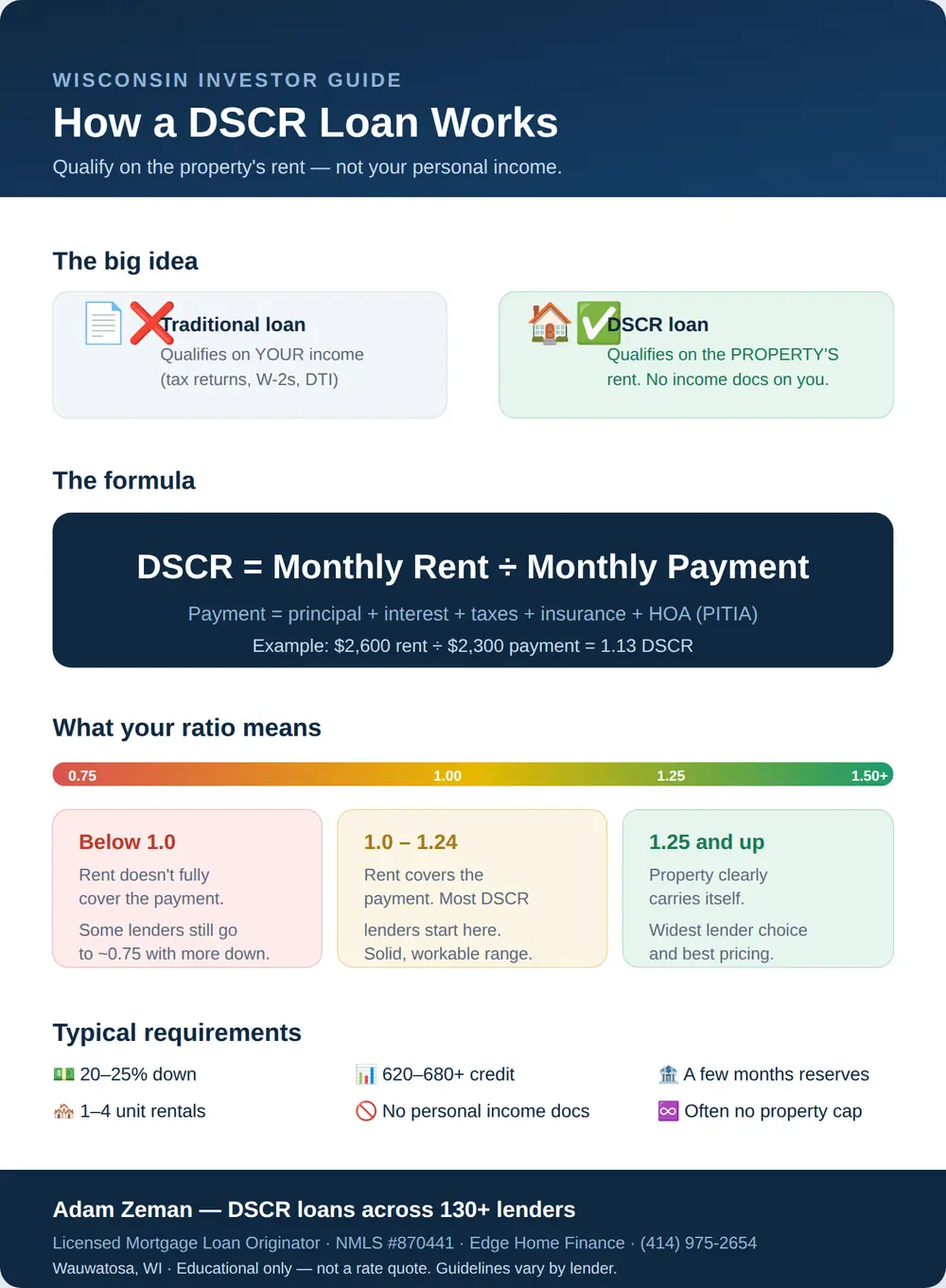
If you’ve tried to finance a rental the traditional way, you know the frustration: your tax returns show write-offs that make your income look small, and a regular lender counts that against you. As a result, a DSCR loan flips the script — it looks at the property’s numbers, not yours.
I’m Adam Zeman, a licensed loan officer with 15+ years in Wisconsin mortgages, and in fact I set these up for investors all the time. Here’s a plain-English walkthrough of what a DSCR loan is, how it works, and who it’s for.
What is a DSCR loan, exactly?
A DSCR loan is an investment-property mortgage that qualifies on the property’s income. “DSCR” stands for debt-service coverage ratio (DSCR) — a simple measure of whether the rent a property brings in covers the mortgage payment it has to carry. Lenders use that ratio in place of looking at your personal paycheck.
And because the property qualifies itself, you also skip the paperwork a normal loan demands: no pay stubs, no W-2s, no tax returns, and no debt-to-income ratio (DTI) calculation on you. That’s why self-employed investors and anyone with heavy write-offs gravitate to them.
How is a DSCR loan different from a regular mortgage?
In short, the difference is what gets examined. A traditional loan underwrites you. A DSCR loan underwrites the property.
| DSCR loan | Traditional mortgage | |
|---|---|---|
| Qualifies on | The property’s rent | Your personal income |
| Income documents | None | Tax returns, W-2s, pay stubs |
| Counts your DTI? | No | Yes |
| How many you can have | Often unlimited | Usually capped |
| Property type | Investment only | Primary, second home, or investment |
How does the DSCR ratio work?
First, the math is short. Then you divide the property’s monthly rent by its full monthly payment — principal, interest, taxes, insurance, and any HOA dues (PITIA).
DSCR = monthly rent ÷ monthly payment (PITIA)
For example, say a duplex rents for $2,600 a month and the full payment is $2,300. That’s a DSCR of about 1.13 — the rent covers the payment with a little cushion. So most lenders want to see at least 1.0; land at 1.25 or higher and you’ll see the best options and pricing.
Who is a DSCR loan for?
So DSCR loans, of course, fit a specific kind of buyer. Specifically, they are built for real estate investors — especially anyone whose tax returns don’t tell the full income story. You’re a strong candidate if you’re:
- For example, self-employed or a business owner with lots of write-offs.
- Growing a rental portfolio faster than a bank’s property cap allows.
- Buying a Milwaukee duplex or two-flat where the combined rent easily covers the payment.
- In fact, an investor who’d rather not hand over years of personal tax returns.
What are the pros and cons of a DSCR loan?
They are powerful; however, they are not free money. Here’s the honest trade-off.
| Pros | Cons |
|---|---|
| No personal income documents | Rate usually a bit higher than a primary-home loan |
| Often no limit on number of properties | Larger down payment (typically 20–25%) |
| Fast — less to underwrite | Investment property only, not your residence |
| Can close in an LLC | Needs the rent to cover the payment |
How do you get a DSCR loan in Wisconsin?
In practice, the single biggest factor is the lender. DSCR guidelines — minimum ratios, down payment, credit, whether short-term rentals count — vary widely from one lender to the next. Send the file to the wrong one and you get a “no” that a different lender would have approved.
That’s exactly the part I handle. I shop your loan across 130+ lenders, so I match your property to the one whose DSCR box it actually fits. For the full breakdown of requirements, rates, and a real example, see my guide to DSCR loans in Wisconsin. And if you already own rentals and want to tap your equity, a cash-out refinance may fit too.
Frequently asked questions
What does DSCR stand for?
Debt-service coverage ratio — the property’s rent divided by its full monthly mortgage payment.
Do DSCR loans check my personal income?
No. In fact, there are no pay stubs, W-2s, or tax returns, and no debt-to-income calculation on you.
What DSCR do I need to qualify?
Most lenders start around 1.0 (rent covers the payment). Some go to about 0.75 with a larger down payment; 1.25+ opens the best pricing.
How much down do I need?
Usually 20–25%. In addition, more down can buy a better rate or help a lower-ratio property qualify.
Can I use a DSCR loan for a Milwaukee duplex?
Yes. For example, 2-to-4-unit properties are a great fit, and the combined rent often makes the ratio stronger.
Are DSCR loans only for LLCs?
No. In fact, you can usually close in your own name or an LLC.
Is a DSCR loan the same as a hard money loan?
No. Hard money is short-term and expensive. By contrast, a DSCR loan is a normal 30-year mortgage that just qualifies differently.
How fast can a DSCR loan close?
Often quicker than a traditional loan, since there’s no personal income to document.
Key takeaways
- A DSCR loan qualifies you on the property’s rent, not your personal income.
- DSCR = monthly rent ÷ monthly payment (PITIA); aim for 1.0 or higher.
- No tax returns, W-2s, or DTI on you — ideal for self-employed investors.
- Also plan on 20–25% down and a slightly higher rate than a primary-home loan.
- Finally, guidelines vary a lot by lender, so who you send the file to decides whether it closes.
Want to see if your property qualifies?
So tell me about the property, and I’ll run the numbers across 130+ lenders and show you exactly where it lands. Grab a 15-minute call on my calendar, or call or text me at (414) 975-2654.
Adam Zeman — Licensed Mortgage Loan Originator, NMLS #870441 — Edge Home Finance, LLC, Company NMLS #891464 — 11220 W Burleigh St, Suite 174, Wauwatosa, WI 53222 — (414) 975-2654 — Book: calendly.com/adam-zeman/30min. Educational information only, not a rate quote or commitment to lend. DSCR loan guidelines, ratios, rates, and reserve requirements vary by lender and by borrower. All loans subject to credit approval and underwriting. Equal Housing Opportunity.