
Buying your first home is equal parts thrilling and terrifying — the excitement of a place that’s finally yours, tangled up with the fear that the numbers won’t work or that you’ll miss something important. If that’s where your head is right now, take a breath. Thousands of Wisconsin families start exactly here, and most of them get to the keys.
I’m Adam Zeman, a licensed loan officer with 15+ years in Wisconsin mortgages, and helping first-time buyers is a big part of what I do. Let me walk you through what it really takes — the down payment, the credit, the steps, and the real dollars — so the process feels less like a mystery and more like a map.
What does a first time home buyer need to qualify?
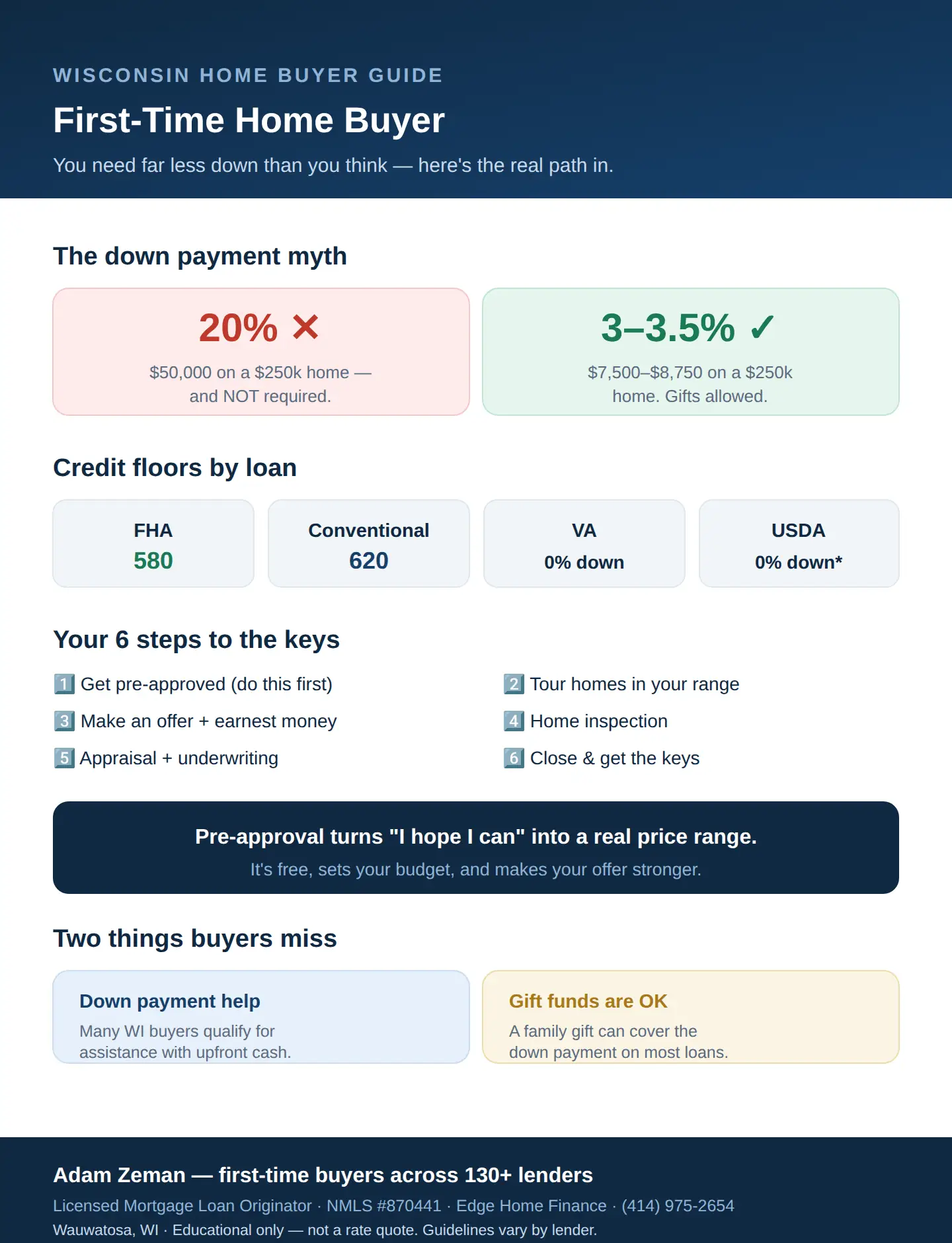
In short, you need three things: enough income to cover the payment, a credit score that clears your loan’s floor, and money for a down payment and closing costs. The good news is that each of those bars is lower than most first-time buyers assume. Here’s the quick picture.
| What you need | Typical starting point |
|---|---|
| Down payment | 3% (conventional) to 3.5% (FHA) — not 20% |
| Credit score | Around 580 (FHA) to 620 (conventional) |
| Debt-to-income ratio (DTI) | Often up to ~43–50% with strong factors |
| Steady income | Usually a two-year work history |
| Closing costs | Roughly 2%–5% of the price (sometimes seller-paid) |
So if you’ve been holding back because you assumed you needed a huge pile of cash and perfect credit, that’s the myth worth letting go of first.
How much down payment does a first time home buyer really need?
Honestly, less than you think. Conventional loans allow as little as 3% down for first-time buyers, and FHA loans ask 3.5%. On a $250,000 home, that’s $7,500 to $8,750 — a world away from the $50,000 that a 20% down payment would require.
Because you’re putting less than 20% down, you’ll usually pay private mortgage insurance (PMI) — a monthly add-on that protects the lender. It’s not forever, though: on a conventional loan it falls off once you reach 20% equity. And your down payment can often come from a gift from family, which helps a lot of first-time buyers get there sooner.
What loans are best for a first time home buyer?
There’s no single “first-timer loan” — instead, a few programs each fit a different situation. The right one usually comes down to your credit and how much you’re putting down.
| Loan | Best for a buyer who… |
|---|---|
| FHA | Has a lower credit score or smaller down payment |
| Conventional | Has stronger credit and wants PMI to drop off later |
| VA | Is a veteran or service member (often 0% down) |
| USDA | Is buying in an eligible rural Wisconsin area (often 0% down) |
For a deeper look, see my guides to FHA loans and conventional loans — the two most common paths for a first time home buyer.
What are the steps to buy your first home in Wisconsin?
Still, the process feels manageable once you break it into steps. Here’s the path most Wisconsin first-time buyers actually follow, start to finish.
- Get pre-approved — this sets your real budget and shows sellers you’re serious.
- Find an agent and start touring homes in your price range.
- Make an offer, and put down earnest money to show good faith.
- Get a home inspection so there are no ugly surprises.
- Let the loan process — appraisal, underwriting, and final approval.
- Close, get the keys, and move in.
Notice that pre-approval comes first, before you fall for a house. That order matters, because it keeps you from shopping in the wrong price range or losing a home you love to a delay.
How much does a first time home buyer need to earn?
In truth, it depends more on your debts than your salary. Because lenders look at your debt-to-income ratio (DTI), a buyer with no car payment can afford more house than a buyer with the same income and a $500 car loan.
As a rough guide, a $250,000 home often fits an income somewhere around $5,500–$6,500 a month, depending on your rate, taxes, and existing debts. Rather than guess, though, a pre-approval gives you the real number — it’s free, and it’s the single most useful first step you can take.
Are there first-time buyer programs in Wisconsin?
Yes. Beyond the low-down-payment loans above, many Wisconsin buyers qualify for down payment assistance that can cover part or all of the upfront cash. Whether one fits depends on your income, the county, and the price of the home. Because these programs change and each has its own rules, I’ll tell you which ones you actually qualify for instead of leaving you to guess.
How do you start as a first time home buyer in Wisconsin?
The honest answer is that it starts with a conversation, not a house. Because your budget, loan type, and down payment all depend on your specific numbers, the smartest first move is a pre-approval that maps it out. That’s what I do — I look at your real situation and shop it across 130+ lenders so you start with the strongest terms. My full first-time home buyer guide is a good companion read.
Frequently asked questions
Do I need to be a first time home buyer to use these programs?
Not always. Many low-down-payment loans are open to anyone, though some assistance programs are reserved for true first-time buyers (often defined as not having owned in three years).
What credit score does a first time home buyer need?
Around 580 for an FHA loan and 620 for a conventional loan. A higher score earns a lower rate, so it’s worth a little effort before you apply.
How much money do I need saved?
Enough for your down payment (3%–3.5%) plus closing costs (2%–5%). On a $250,000 home, that’s often in the $13,000–$20,000 range, though gifts and seller credits can shrink it.
Can I buy with student loan debt?
Often yes. Student loans count in your DTI, but they rarely rule you out on their own — plenty of first-time buyers close with them.
How long does buying a first home take?
Commonly 30–45 days from accepted offer to closing, though getting pre-approved early keeps everything moving.
Should I get pre-approved before looking at homes?
Yes, always. It sets your budget and makes your offer stronger, and it’s the first thing sellers look for.
Can my down payment be a gift?
In most cases, yes. A gift from a family member is a common and fully allowed way for a first time home buyer to fund the down payment.
What if my credit isn’t great yet?
You may still qualify, especially with FHA — and if not yet, I’ll give you a short, specific plan to get there rather than a flat no.
Key takeaways
- A first time home buyer in Wisconsin usually needs just 3%–3.5% down, not 20%.
- Credit floors are around 580 (FHA) or 620 (conventional), and a higher score means a lower rate.
- Pre-approval comes first — it sets your real budget and strengthens your offer.
- Also look into down payment assistance; many Wisconsin buyers qualify for help with the upfront cash.
- Your down payment can often be a gift, which gets a lot of first-time buyers to the keys sooner.
Ready to take the first step?
Let’s find out what you qualify for — the real number, across 130+ lenders, with no pressure. Grab a 15-minute call on my calendar, or call or text me at (414) 975-2654.
Adam Zeman — Licensed Mortgage Loan Originator, NMLS #870441 — Edge Home Finance, LLC, Company NMLS #891464 — 11220 W Burleigh St, Suite 174, Wauwatosa, WI 53222 — (414) 975-2654 — Book: calendly.com/adam-zeman/30min. Educational information only, not a rate quote or commitment to lend. Loan guidelines, down payment, and credit requirements vary by lender and by borrower. All loans subject to credit approval and underwriting. Equal Housing Opportunity.