
When you’re sizing up a rental, the suspense is simple: does this property pay for itself? A DSCR loan calculator answers that in seconds, before you fall for a deal or waste time on one that won’t pencil. It’s the fastest gut-check an investor has.
I’m Adam Zeman, a licensed loan officer with 15+ years in Wisconsin mortgages, and I run these numbers with investors all the time. Let me show you exactly how a DSCR loan calculator works, walk through real examples, and tell you what ratio you actually need.
How does a DSCR loan calculator work?
In short, it’s one division problem. You take the property’s monthly rent and divide it by the full monthly payment — and that payment isn’t just principal and interest. It includes taxes, insurance, and any HOA dues, which lenders lump together as PITIA. The result is your DSCR.
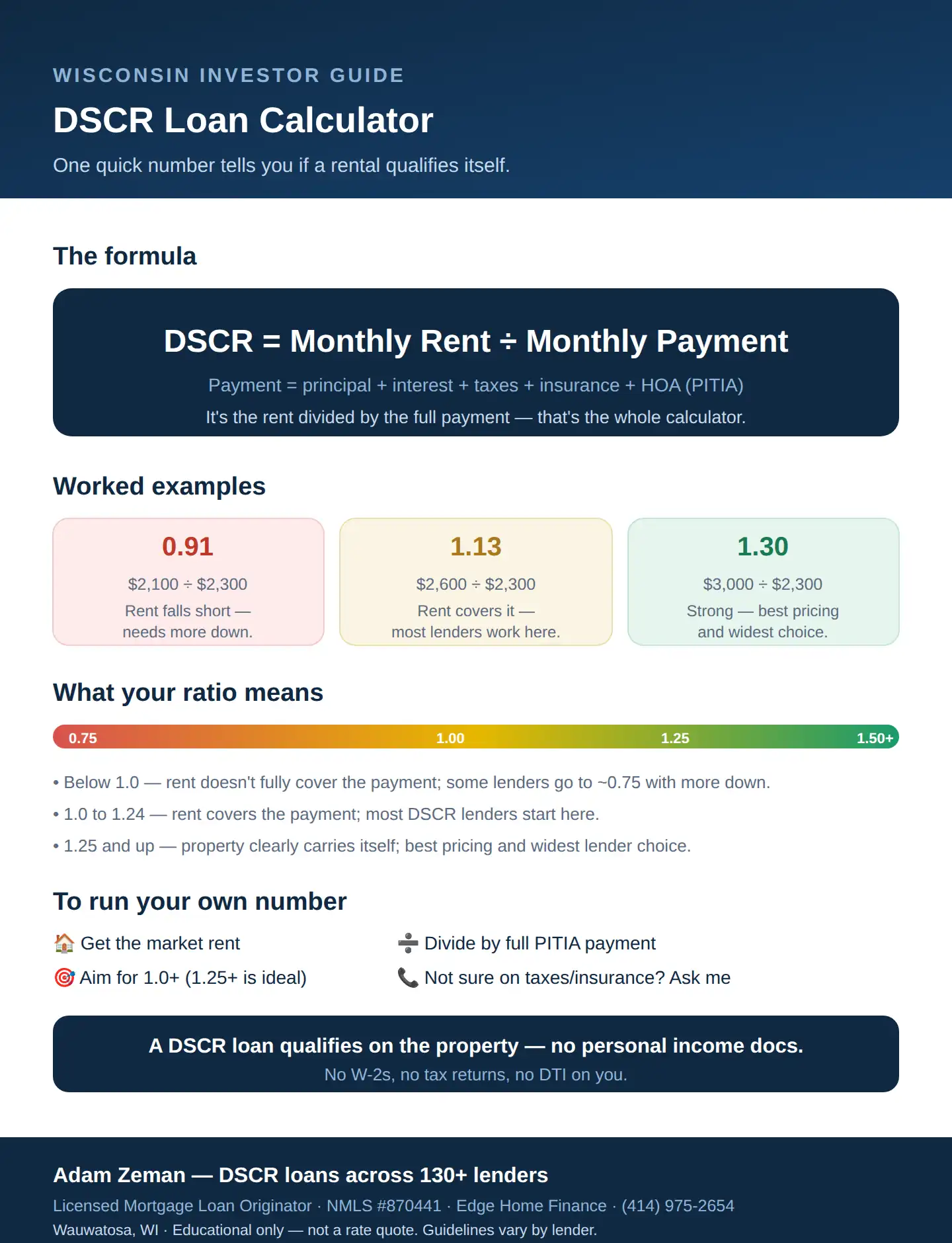
DSCR = monthly rent ÷ monthly payment (PITIA)
So the whole “calculator” is really that single formula. The trick is getting the payment right, because forgetting taxes or insurance will make a property look better than it is.
What does a DSCR loan calculator show you?
It shows whether the rent covers the mortgage, and by how much. Because that ratio is exactly what a lender uses to qualify the property, your calculator result is a strong preview of your approval. Here’s how the numbers play out.
| Rent | Payment (PITIA) | DSCR | What it means |
|---|---|---|---|
| $2,100 | $2,300 | 0.91 | Rent falls short; needs more down |
| $2,600 | $2,300 | 1.13 | Rent covers it; most lenders work here |
| $3,000 | $2,300 | 1.30 | Strong; best pricing and widest choice |
Notice how a $500 swing in rent moves you from “needs work” to “clearly qualifies.” That’s why running the DSCR loan calculator early is so useful — it tells you what rent, or what down payment, the deal really needs.
What DSCR ratio do you need to qualify?
Most lenders start at 1.0, where the rent exactly covers the payment. Some will go as low as about 0.75 if you put more down, and once you reach 1.25 or higher, you’ll see the best rates and the widest lender choice. In other words, higher is always better, but you don’t need a huge number to get started.
For a fuller breakdown of how the loan itself works, see my guide to DSCR loans in Wisconsin, or start with the basics in what a DSCR loan is.
How to use a DSCR loan calculator on a real property
Let’s make it concrete. First, get the market rent for the unit — a lease or a rent appraisal both work. Next, add up the full payment: principal and interest, plus taxes, insurance, and any HOA. Finally, divide the rent by that payment. That’s your DSCR.
For example, say a Milwaukee two-flat brings in $2,900 a month combined and the full payment is $2,400. Dividing gives a DSCR of about 1.21 — comfortably in the range most lenders like. If you’re unsure of the taxes or insurance for a specific property, that’s exactly the kind of number I can pin down for you.
Why is my DSCR loan calculator result different from a lender’s?
Usually it comes down to the inputs. A lender may use a market-rent figure from an appraisal rather than your asking rent, and their payment estimate includes the exact taxes and insurance for that property. So your quick calculator gives a great preview, while the lender’s version is the official one — and because guidelines vary, the same ratio can land differently from one lender to the next.
How do you turn a good DSCR into a loan in Wisconsin?
The honest answer is that a strong DSCR is only half the story; the other half is the lender. Because each lender sets its own minimum ratio, down payment, and credit rules, the same property can get very different answers. That’s the part I handle — I run your real numbers and shop the file across 130+ lenders to find the one your deal fits best.
Frequently asked questions
What does a DSCR loan calculator measure?
In short, it measures whether a rental’s income covers its mortgage, by dividing monthly rent by the full monthly payment (PITIA).
What is a good DSCR?
1.0 means rent covers the payment. 1.25 or higher is strong and opens the best pricing; some lenders accept around 0.75 with more down.
Does the DSCR loan calculator include taxes and insurance?
Yes. In fact, the payment should be full PITIA — principal, interest, taxes, insurance, and HOA — or the ratio will look too high.
Can I use projected rent for a short-term rental?
Sometimes. Certain lenders allow a projection, but many want a rental history to support the income.
Does my personal income go into the calculator?
No. Instead, a DSCR loan qualifies on the property, so there are no W-2s, tax returns, or personal DTI involved.
What if my DSCR is below 1.0?
Still, you may qualify with a larger down payment, or by finding a lender that allows lower ratios. Run the numbers before you assume no.
How much down payment do DSCR loans need?
Usually 20–25%. More down lowers the payment, which raises your DSCR and can improve your rate.
Can a DSCR loan calculator tell me my rate?
Not exactly. It shows whether the property qualifies; the rate depends on your credit, down payment, and the lender.
Key takeaways
- A DSCR loan calculator divides monthly rent by the full payment (PITIA) to give your ratio.
- Most lenders want 1.0 or higher; 1.25+ unlocks the best pricing.
- Include taxes and insurance, or the calculator will overstate your ratio.
- Also remember the calculator is a preview — the lender’s inputs make it official.
- A strong DSCR still needs the right lender, since guidelines vary widely.
Want your property’s real DSCR?
Send me the rent and the property details, and I’ll run the exact ratio and show you where it lands across 130+ lenders. Grab a 15-minute call on my calendar, or call or text me at (414) 975-2654.
Adam Zeman — Licensed Mortgage Loan Originator, NMLS #870441 — Edge Home Finance, LLC, Company NMLS #891464 — 11220 W Burleigh St, Suite 174, Wauwatosa, WI 53222 — (414) 975-2654 — Book: calendly.com/adam-zeman/30min. Educational information only, not a rate quote or commitment to lend. DSCR loan guidelines, ratios, and requirements vary by lender and by borrower. All loans subject to credit approval and underwriting. Equal Housing Opportunity.