
Deciding what happens to the house is one of the hardest parts of a divorce — it’s tied up in money, memories, and the practical question of who can actually afford to stay. Knowing your options ahead of time turns a stressful unknown into a decision you can make with clear eyes.
I’m Adam Zeman, a licensed loan officer with 15+ years in Wisconsin mortgages, and I walk people through this carefully and privately. Here’s a plain look at the three divorce mortgage options, when each one fits, and how to tell which is right for you.
What are the divorce mortgage options?
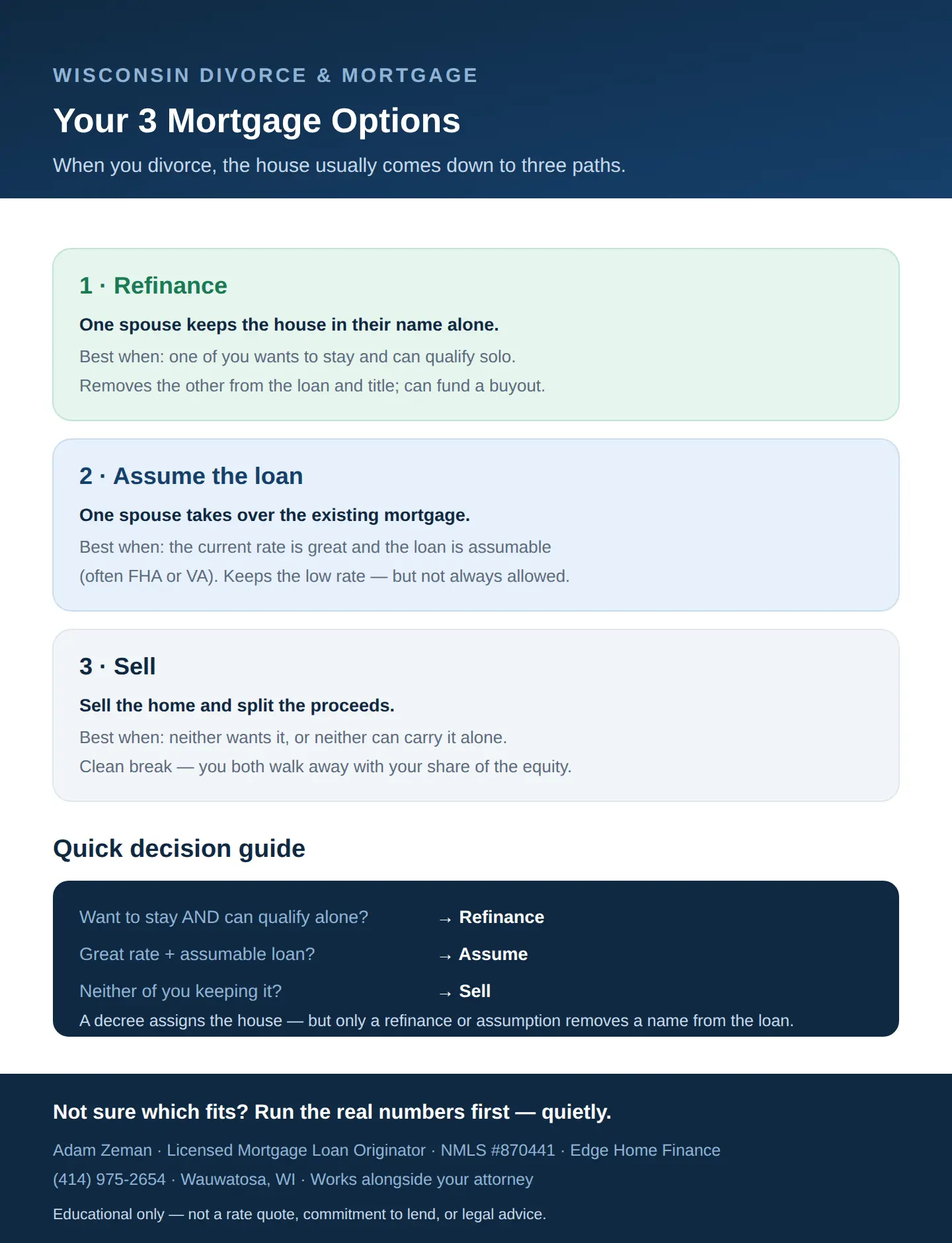
In short, there are three: refinance, assume, or sell. Each one settles the home differently, and the right choice depends on whether someone wants to keep it and whether they can carry it alone. Here’s the quick comparison before we dig in.
| Option | Best when… |
|---|---|
| Refinance | One spouse keeps the home and can qualify solo |
| Assume the loan | The rate is great and the loan is assumable |
| Sell | Neither wants it, or neither can carry it alone |
Option 1: Refinance to keep the house
Refinancing puts the home and the mortgage entirely in one spouse’s name. You take out a new loan on your own, pay off the joint mortgage, and can pull equity to buy out your ex’s share. Because the loan is now yours alone, this cleanly removes your ex from both the mortgage and the title.
So refinancing is the go-to when one of you wants to stay and can qualify on your own income. If that’s you, my guide to a refinance in Wisconsin walks through the details.
Option 2: Assume the existing loan
The second of the divorce mortgage options, assuming, means one spouse takes over the current mortgage instead of getting a new one. The big advantage is the rate: if your existing loan carries a low rate, an assumption lets you keep it rather than refinancing into today’s market. That can save a lot of money each month.
Still, there’s a catch. Not every loan is assumable — government loans like FHA and VA often are, while most conventional loans are not. And you’ll usually still need to qualify to take it over on your own. So it’s a great option when it’s available, which is exactly what I can check for you.
Option 3: Sell and split the proceeds
Among the divorce mortgage options, selling is sometimes the cleanest path. When neither spouse wants the house, or neither can comfortably afford it alone, selling turns the home into cash you can divide and move on from. It’s often the simplest emotionally, too, because it draws a clear line.
After the sale pays off the mortgage and costs, the remaining equity is split according to your divorce agreement. Then you both walk away with your share and a fresh start.
How do I choose between the divorce mortgage options?
It comes down to two questions: does someone want to keep the house, and can they carry it alone? If yes to both, refinancing (or an assumption, if the loan allows) keeps it. If no to either, selling is usually the answer.
Because the numbers decide so much of this, it helps to see them early. That’s the part I handle — I’ll show you privately whether keeping the home is realistic on one income before you commit to anything.
Does a divorce decree remove my name from the mortgage?
No, and this trips up a lot of people weighing their divorce mortgage options. A divorce decree can say who is responsible for the house, but it does not remove anyone from the loan. Until you refinance or the loan is assumed, both names stay on the mortgage — and it keeps affecting both credit reports. So whichever option you choose, that’s the step that actually separates your finances.
Frequently asked questions
Which of the divorce mortgage options is best?
It depends on your situation. Refinancing keeps the home for one spouse, assuming preserves a great rate, and selling gives a clean split.
Can I keep the house after divorce?
Often yes, if you can qualify for the loan on your own income through a refinance or an assumption.
What does it mean to assume a mortgage?
It means taking over the existing loan and its rate, rather than getting a new one. It’s mainly available on FHA and VA loans.
Does refinancing remove my ex from the loan?
Yes. A refinance in your name alone pays off the joint loan and releases your ex from the mortgage.
What if I can’t afford the house alone?
Then assuming or selling may fit better. It’s worth running the numbers before assuming you have to sell.
Is selling always the simplest option?
Often, emotionally and financially, since it divides the equity cleanly. But it isn’t the only path if one of you wants to stay.
Can support payments help me qualify to keep the home?
Sometimes. Established child support or maintenance can count as income, depending on the details.
How long do these take?
A refinance is commonly 30 to 45 days; a sale depends on the market. Aligning either with your divorce timeline matters.
Key takeaways
- The three divorce mortgage options are refinance, assume the loan, or sell.
- Refinance keeps the home for one spouse and can fund a buyout; you qualify on your own.
- Assuming preserves a low existing rate, but mainly on FHA and VA loans.
- Also remember a divorce decree does not remove a name from the loan — only a refinance or assumption does.
- When neither can or wants to keep it, selling gives a clean, even split.
Not sure which path fits?
Tell me your situation and I’ll run the numbers privately, alongside your attorney, so you can decide with confidence. Grab a 15-minute call on my calendar, or call or text me at (414) 975-2654.
Adam Zeman — Licensed Mortgage Loan Originator, NMLS #870441 — Edge Home Finance, LLC, Company NMLS #891464 — 11220 W Burleigh St, Suite 174, Wauwatosa, WI 53222 — (414) 975-2654 — Book: calendly.com/adam-zeman/30min. Educational information only, not a rate quote, commitment to lend, or legal advice. Loan guidelines and qualifying vary by lender and by borrower. All loans subject to credit approval and underwriting. Equal Housing Opportunity.