
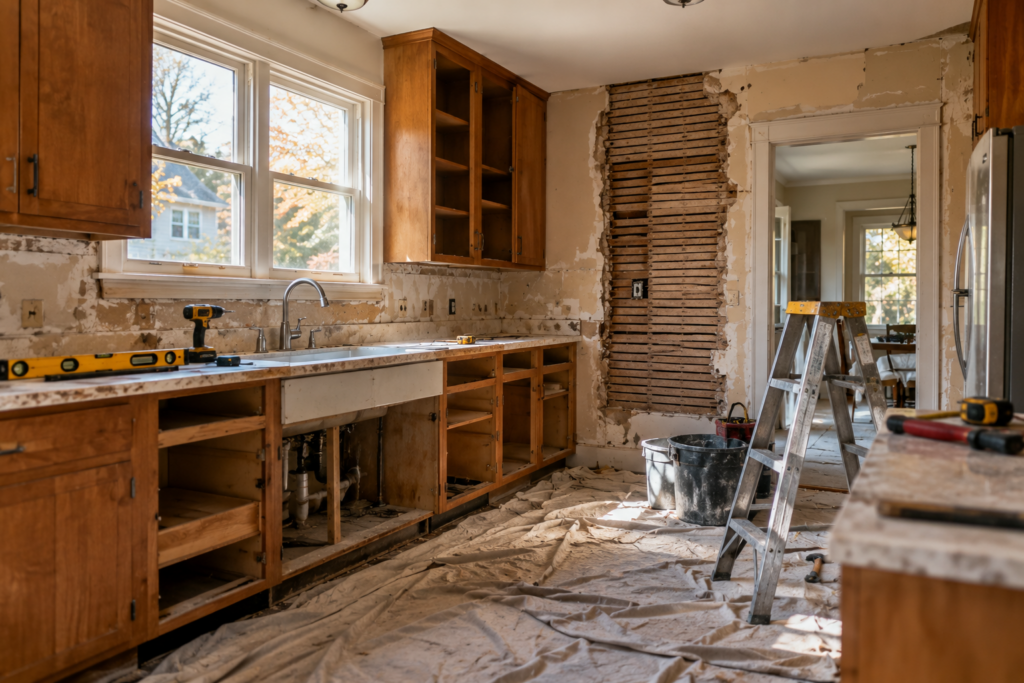
You walk through a 1940s bungalow in Wauwatosa. Good bones, great street, priced $40,000 under everything else you’ve seen. Then you open the bathroom door and understand why. This is exactly the house a renovation loan in Wisconsin is built for.
Most buyers walk back out. The ones who don’t are usually using a renovation loan in Wisconsin — a mortgage that lets you borrow against what the house will be worth after the work, not what it’s worth on the day you’re standing in that bathroom.
One loan, one closing, one monthly payment. Here’s how it actually works and when it’s worth the extra effort.
What is a renovation loan, and how is it different from a regular mortgage?
A renovation loan wraps the purchase price and the repair budget into a single mortgage, and it’s underwritten on the home’s as-completed value — the appraiser’s estimate of what the property will be worth once the planned work is finished.
That’s the whole trick. A normal mortgage looks at the house as it sits today, which is a problem when today includes a kitchen from the Carter administration. A renovation loan looks at the plan and the appraisal of the finished product.
The money for the work doesn’t land in your checking account. It goes into an escrow account, and the lender releases it to your contractor in draws as the work passes inspection. You close, the work happens, the funds pay out along the way.
What are the main renovation loan options?
Three programs cover almost every situation, and the right one depends on how big the job is and how much down payment you have. Those are the three main flavors of a renovation loan in Wisconsin.
| Program | Best for | Things to know |
|---|---|---|
| FHA 203(k) Limited | Cosmetic and non-structural work | Capped around $75,000 in renovation costs; no structural changes; 3.5% down |
| FHA 203(k) Standard | Big jobs, including structural | No set cap beyond FHA loan limits; requires a HUD consultant; 3.5% down |
| Fannie Mae HomeStyle | Conventional buyers, wide range of projects | Renovation funds up to 75% of as-completed value; often 5% down; no mortgage insurance once you reach 20% equity |
However, program limits get updated periodically, so treat those figures as the shape of the thing rather than gospel on the day you read this. Freddie Mac has a similar conventional option called CHOICERenovation, and for smaller refresh projects there are lighter-touch versions of these programs too.
In short, FHA if your credit or down payment is tighter, HomeStyle if you’re a stronger borrower who wants fewer restrictions on what counts as an eligible improvement.
How much can you actually borrow?
Your loan uses the lesser of the as-completed appraised value or the purchase price plus renovation costs — so the appraisal of the finished home sets your ceiling.
Here’s what that looks like on a real Milwaukee-area scenario:
| Buying a West Allis bungalow | Amount |
|---|---|
| Purchase price | $250,000 |
| Renovation budget (kitchen, bath, electrical) | $45,000 |
| Total project | $295,000 |
| As-completed appraised value | $320,000 |
| FHA down payment (3.5% of $295,000) | $10,325 |
| Equity the day the work finishes | ≈ $25,000 |
That last line is the part people miss. Because you’re buying below market and improving the property, you can land with real equity the moment the contractor packs up — instead of paying full retail for someone else’s finished renovation and starting at zero.
Illustrative numbers, obviously. Your appraisal decides the real ones.
What can the money be used for?
More than most people assume. Kitchens, bathrooms, roofs, windows, furnaces, electrical, plumbing, flooring, additions, accessibility changes, and mold or lead remediation all generally qualify.
However, the differences show up at the edges. FHA’s Limited 203(k) won’t cover structural work — if you’re moving walls or touching the foundation, that’s the Standard version. FHA programs have historically been stricter about what they consider luxury improvements, while HomeStyle is broader and will generally finance things like a pool, which FHA won’t.
What none of them cover: work you plan to do yourself to save money. Lenders want licensed contractors with signed bids, because the loan is secured by a finished house, not by good intentions and a YouTube tutorial.
How does the money actually get paid out?
In stages, and only after an inspector verifies the work — not upfront.
At closing, the seller gets the purchase price, and the renovation funds move into escrow. Then the real work starts. Your contractor works, an inspector confirms each phase is genuinely done, and a draw gets released. Repeat until the project is complete. Most programs expect the work to finish within a set window, commonly around six months. That draw schedule is the part of a renovation loan in Wisconsin that surprises people most.
Practically, this means your contractor needs to be comfortable with draw schedules and paperwork. A great contractor who has never done a 203(k) can absolutely learn it, but find that out in week one rather than week six.
If you already own the home and just want to renovate, you don’t need this at all — a cash-out refinance on your current home is usually simpler and has none of the draw-schedule machinery.
What is the catch?
They take longer and involve more people. That’s the honest trade.
You’re coordinating bids, a specialized appraisal, sometimes a HUD consultant, an inspector for each draw, and an underwriter who wants all of it documented. Expect a longer closing than a standard purchase, and expect to make decisions early — the scope has to be nailed down before you close, which means choosing finishes when you’d rather be daydreaming.
Here’s when I’ll tell you to skip it. If the work is small enough to handle with savings after closing, a regular mortgage is faster and simpler. If you’re in a competitive multiple-offer situation, a renovation loan can make your offer less attractive on timeline alone. And if the house needs so much that the as-completed value still doesn’t support the numbers, the honest answer is that it’s the wrong house, not the wrong loan.
Before you fall for a fixer, it’s worth getting pre-approved for the renovation scenario specifically, because your buying power is calculated differently than on a standard purchase.
Who is this perfect for in the Milwaukee suburbs?
Buyers who want a specific neighborhood more than they want a finished house.
The housing stock around here is made for this. Wauwatosa bungalows, West Allis Cape Cods, older ranches in Waukesha and New Berlin — solidly built homes on established streets, many owned by the same family for decades and never updated. They’re the listings that sit while the renovated house two blocks over gets seven offers.
That gap is where a renovation loan in Wisconsin earns its keep. If you can tolerate a few months of dust, a renovation loan often gets you into a better street than your budget would otherwise reach — and lets you build the kitchen you actually wanted instead of inheriting someone else’s taste in backsplash.
Frequently asked questions about a renovation loan in Wisconsin
Can I do the work myself?
Generally no. These programs require licensed contractors with documented bids.
How much down payment do I need?
As little as 3.5% on FHA 203(k), commonly 5% on HomeStyle — calculated on the total project, not just the purchase price.
Can I use one to refinance a home I already own?
Yes, these programs have refinance versions. But if you have equity, a straight cash-out refinance is usually simpler.
How long does the work have to take?
Most programs set a completion window, commonly around six months from closing.
Does the house have to be livable during construction?
Not necessarily. Some programs allow financing a few months of mortgage payments when the home can’t be occupied during the work.
Will the appraisal count my renovation plans?
Yes — that’s the entire point. The appraiser values the home as-completed based on your submitted scope and bids.
Key takeaways on a renovation loan in Wisconsin
- A renovation loan in Wisconsin lets you finance the purchase and the repairs in one mortgage, based on the home’s as-completed value.
- FHA 203(k) Limited handles cosmetic work, 203(k) Standard handles structural, and HomeStyle is the conventional option with the widest scope.
- Down payments start around 3.5% FHA or 5% conventional, calculated on the total project.
- The lender releases funds to licensed contractors in draws as an inspector checks the work — not paid to you upfront.
- Expect a longer closing and more paperwork. If the job is small, a standard loan and savings is simpler.
- If you already own the home, a cash-out refinance is usually the easier path.
Found a house with good bones and a bad kitchen?
Send me the address and a rough repair budget. I’ll tell you whether a renovation loan works on that specific house, what your down payment would be in real dollars, and whether the numbers actually support the project — before you write an offer. You reach me directly, and I answer my own phone.
Call or text me:
Adam Zeman : Edge Home Finance
I’m Adam Zeman — a Wisconsin loan officer who’d rather talk you out of the wrong loan than close it. I work with buyers across Milwaukee, Waukesha County, and the surrounding suburbs.
Senior Loan Originator · NMLS #870441
Edge Home Finance, LLC · NMLS #891464 · Licensed in Wisconsin
📞 (414) 975-2654 · azeman@edgehomefinance.com · adamzmortgageteam.com
YouTube: @Adamzmortgageteam · Reddit: u/azem4356
Read this next: How mortgage pre-approval works in Wisconsin
Educational only — not a rate quote. Program limits, eligible improvements, and qualifying guidelines vary by lender, loan program, and borrower, are updated periodically, and not all borrowers or properties will qualify. Edge Home Finance, LLC is a private broker, not affiliated with HUD, the FHA, or any government agency.